APEX Column
APEX Column
Brought to you by APEX Plastic Surgery
Explore plastic surgery insights and stories.
Breast Augmentation: Looking at Body Type, Breast Width, and Skin Elasticity Before Implant Size
Date : 2026-11-26
Views : 27
In breast augmentation, implants are not chosen based solely on desired size; instead, the breast width, position, skin elasticity, and body type are measured to determine the implant size and placement site. Since the palpability of the implant and scarring vary depending on the implant placement plane and incision site, these are thoroughly discussed during the consultation.
The reasons people be concerned about small breasts differ from person to person. Some have naturally underdeveloped breasts, while others experience volume loss following childbirth or weight loss. Even with similar concerns, the appropriate implant and surgical approach vary depending on the breast's condition, so we have outlined what we examine and how decisions are made during a breast augmentation consultation.

AI-generated image for illustrative purposes.
Breast Augmentation Consultation: Measuring Body Type Before Desired Size
Breast augmentation is not simply a procedure to create large breasts, but one to find volume that balances well with your body type and proportions. APEX Plastic Surgery analyzes the following four factors before surgery.
- Body Type — We measure your visible body frame and determine the volume size that best suits you.
- Breast Proportions — We examine the shape, position, and angle of the breasts from multiple angles.
- Desired Look — We determine the degree of volume and implant placement site according to your desired appearance and personal preferences.
- Implant — We select the implant type and size that best fit the analysis above.
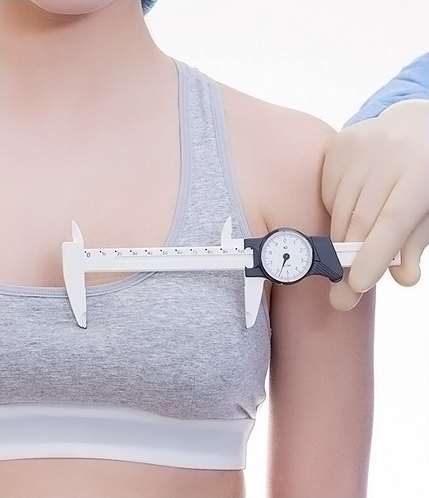
Measuring breast width. Informational image from the APEX Plastic Surgery website.
We also evaluate skin elasticity, body weight, and pregnancy history. If an implant that does not fit your body type is chosen, the breasts may appear excessively large, or conversely, excess skin may make them look sagging.
Common reasons for breast augmentation consultations include:
- Naturally small breasts due to underdeveloped breast tissue
- Loss of breast volume after childbirth
- Loss of breast volume due to weight loss
- Breast size being out of proportion with the body frame
- Wanting to improve both breast shape and tactile feel
Here is the key point — Implant size in breast augmentation is determined not just by desired size, but by measuring breast width, position, skin elasticity, and body type.
Breast Implants Are Categorized by Surface, Shape, and Size
Breast implants come in various types, including smooth implants with a slick surface and textured implants with a rough surface, as well as round implants that are convex in the center and anatomical (tear-drop) implants that are fuller at the bottom. There is no single "best" implant; the right choice varies depending on the breast's position, shape, and skin elasticity.
APEX Plastic Surgery recommends smooth cohesive silicone gel implants. Cohesive silicone gel has strong intermolecular cohesion, preventing it from leaking or running like a liquid. Even within the same implant type, sizes and projection profiles vary, so we select one tailored to your breast width and body type.

Implants with different sizes and projections. Informational image from the APEX Plastic Surgery website.
The implant manufacturer, certifications, and warranty details are also reviewed during the consultation prior to surgery.
Three Placement Planes for Implants
Implants are categorized into three placement planes depending on where they are inserted relative to the pectoral muscle (pectoralis major) and breast tissue. Each has specific indications and considerations.
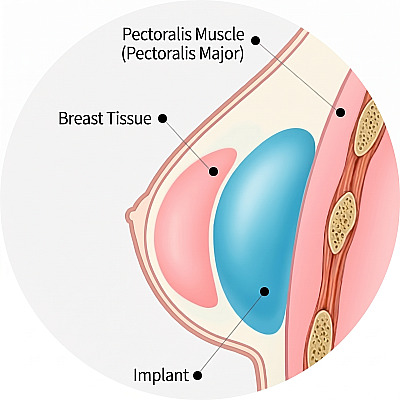
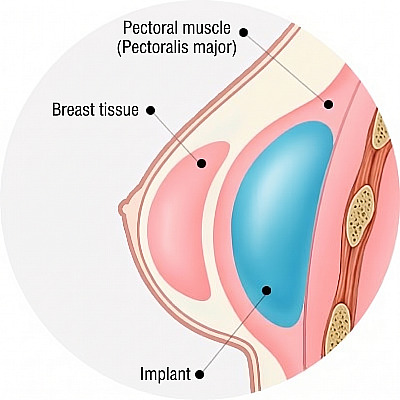
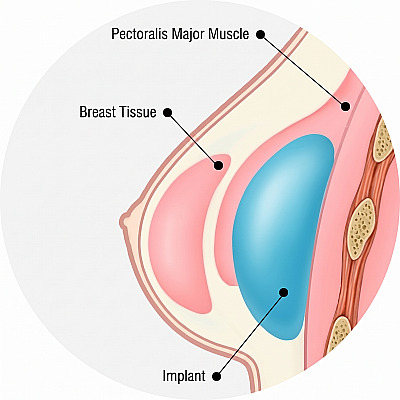
Cross-sectional side view of implant placement planes. From left: subglandular (beneath breast tissue), submuscular (beneath the chest muscle), and dual-plane. Informational diagram from the APEX Plastic Surgery website.
- Subglandular (Beneath Breast Tissue) — Placed above the chest muscle and beneath the breast tissue. This is considered when the pectoral muscles are well-developed or there is moderate breast sagging. For very slender patients or those with minimal breast tissue, the implant may be palpable, and there is a higher risk of capsular contracture, requiring careful monitoring.
- Submuscular (Beneath Chest Muscle) — Placed beneath the chest muscle. Because muscle covers the implant, direct palpability of the implant is reduced. In sagging breasts, the inframammary fold may appear unnatural or create a double-bubble effect.
- Dual-Plane — The upper portion of the implant is placed under the muscle, while the lower portion sits under the breast tissue. The extent of muscle coverage is adjusted according to the breast shape.
The placement plane is determined based on breast tissue thickness, degree of sagging, and overall body type.
Breast Augmentation Incision Sites and Procedure Time
Breast augmentation at APEX Plastic Surgery is performed through an incision of approximately 3 to 4 cm along the inframammary fold. This location is concealed within the breast crease, allowing direct visualization while creating the implant pocket. An endoscope is used to ensure a clear view during tissue dissection.
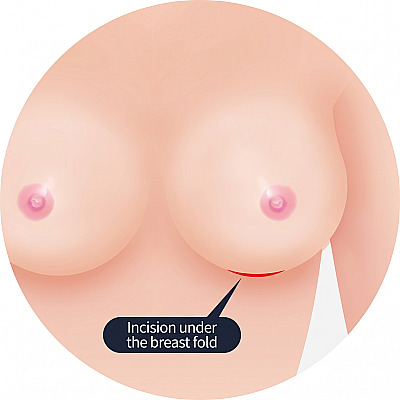
Inframammary fold incision site. Informational diagram from the APEX Plastic Surgery website.
Because a scar forms along the inframammary fold, the scar location and postoperative scar care instructions are thoroughly reviewed prior to surgery. The inframammary fold incision is also utilized in breast revision surgery or for breasts with severe sagging.
General procedure guidelines for breast augmentation are as follows:
- Surgery Duration — Approx. 2 hours
- Anesthesia — IV sedation
- Hospitalization — Not required
- Suture Removal — After 1 week
- Clinic Visits — 2–3 visits
- Recovery Period — About 1 week
APEX Plastic Surgery's Breast Augmentation These are general guidelines. They may vary depending on the patient's condition and the surgical method.
The recovery period refers to the timeframe for returning to daily routines. Swelling subsidence and scar maturation take place over several months. You will receive detailed instructions regarding when you can resume showering, exercising, and wearing regular bras according to the extent of your surgery.
Please keep in mind — Complications such as postoperative bleeding, infection, inflammation, scarring, asymmetry, sensory changes, capsular contracture, implant palpability or visibility, and implant rupture may occur. Capsular contracture is a condition where the capsule forming around the implant thickens and hardens. Recovery processes and results vary by individual. Precautions will be explained in detail during your consultation.
Frequently Asked Questions
When is the best time to have breast surgery?
There is no set season. However, if you have an important event such as a summer vacation or a wedding, we recommend scheduling your surgery date by counting backward, taking into account the time needed for swelling to subside and scars to settle.
How is the implant size decided?
It is determined by measuring breast width, skin elasticity, breast tissue thickness, and body type along with your desired volume. Larger implants are not always better; it is important to find a size that matches your body's proportions.
Can I also have a consultation for breasts that became smaller and sagged after childbirth?
Breasts that have shrunk after childbirth are also candidates for breast augmentation consultation. If sagging is also present, the implant placement plane and surgical method are decided based on the degree of sagging.
What should I do if I am bothered by large areolas or overly large breasts?
If you are concerned about wide areolas, consider Areola (Reduction / Bump Removal), and if you experience discomfort from large breasts, consider Breast Reduction. If you have multiple concerns, the method and sequence will be decided after an examination.
When can I return to work after surgery?
The standard recovery period is about 1 week. Because the return-to-work timing may vary depending on your occupation, it will be planned around your work during the consultation.
Breast Augmentation: Decided after assessing body type and breast condition
What we examine first during consultation
- Body Type — Balance between body type and breasts
- Breast width and position — Breast shape, position, and angle
- Skin and tissue — Skin elasticity and breast tissue thickness
- Sagging — Whether the breasts sag and the degree of sagging
- Childbirth and weight changes — Childbirth history, recent weight changes
- Desired volume — Desired size and shape
- Prior surgeries — Whether you have had previous breast surgery
At APEX Plastic Surgery, board-certified plastic surgeon Dr. Song Hyun-seok provides all consultations and treatments.
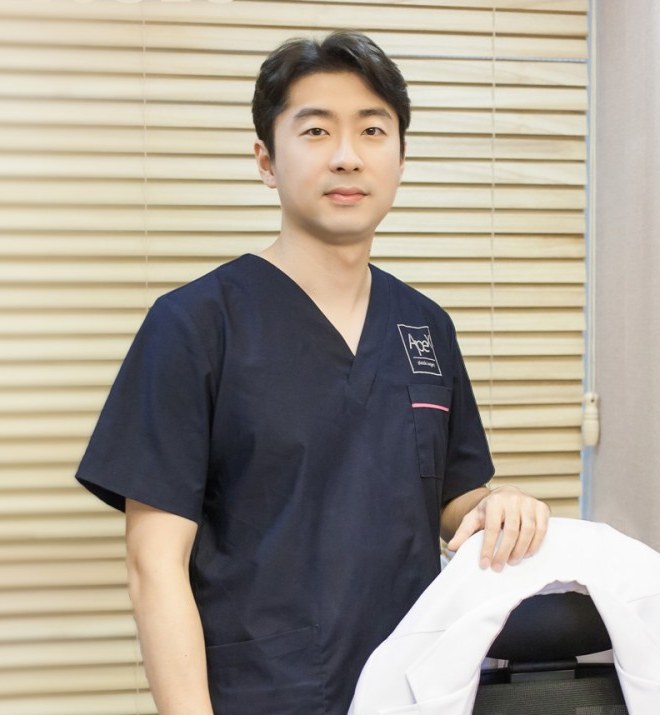
Song Hyun-seok, Head Director · Board-Certified Plastic Surgeon, Ph.D.
This article is provided for medical information purposes only, does not guarantee specific treatment outcomes, and does not replace consultation with a physician. The representative image is an AI-generated image for illustrative purposes, and the breast width measurement photo, implant photo, implant placement diagram, and incision site diagram are informational images from the APEX Plastic Surgery website. None of the images in this article are before-and-after comparison photos. Details such as surgery duration, anesthesia, stitch removal, and recovery period are general guidelines from the APEX Plastic Surgery website and may vary depending on the individual. Potential side effects such as postoperative bleeding, infection, and inflammation can vary in severity by individual, so caution is required. Please receive a thorough consultation, explanation, and provide informed consent prior to surgery.
Medical review: Song Hyun-seok, Director (Board-Certified Plastic Surgeon) · 2026.11.13
APEX CUSTOMER CENTER
Phone number :
02-3453-7907
Clinic Hours
Weekdays
AM 10 : 00 ~ PM 7 : 00
Saturday
AM 10 : 00 ~ PM 4 : 00
(Closed Sundays and holidays)
Subway Line 2, Yeoksam Station Exit 4, Hanjungang Building 3F
The two buildings are adjoined; please enter through the right-hand door.
(The right-hand building with KT on the 1st floor)
How do I make a reservation?
You can book by phone at our main number, 02-3453-7907.
Can I get a consultation in Japanese?
You can reach us via our official Instagram (@apexjapan_official) or X (@apex_surgery).
日本 SNS

Clinic Name : APEX Plastic Surgery
Address : 3F Hanjungang Bldg., 139-1 Teheran-ro, Gangnam-gu, Seoul (646-7 Yeoksam-dong)
CEO : Song Hyun-seok Business Registration No. : 220-10-15955 TEL : 02-3453-7907 FAX : 02-3453-7908
Copyright ⓒ 2026 APEX Plastic Surgery. ALL Rights Reserved.
Apex
[Summit, top]
APEX means ‘the summit,’ ‘the very top.’
with the finest medical technology and a systematized surgical process
our commitment to uncovering the hidden beauty unique to each patient
It embodies the spirit of APEX Plastic Surgery.


