APEX Column
APEX Column
Brought to you by APEX Plastic Surgery
Explore plastic surgery insights and stories.
Rhinoplasty: Is Raising Only the Bridge Enough? Why You Must Also Consider the Tip's 'Skin Limit'
Date : 2026-10-08
Views : 116
Because the nose is in the very center of the face, its shape and height can significantly alter your facial impression. Therefore, rather than aiming solely for a "defined nose and high bridge," harmony with your facial shape and the range the nasal tip skin can accommodate must be evaluated together. Here is an overview of what to consider beyond the bridge, what the nasal tip skin limit is and why it matters, and what is evaluated during consultation.
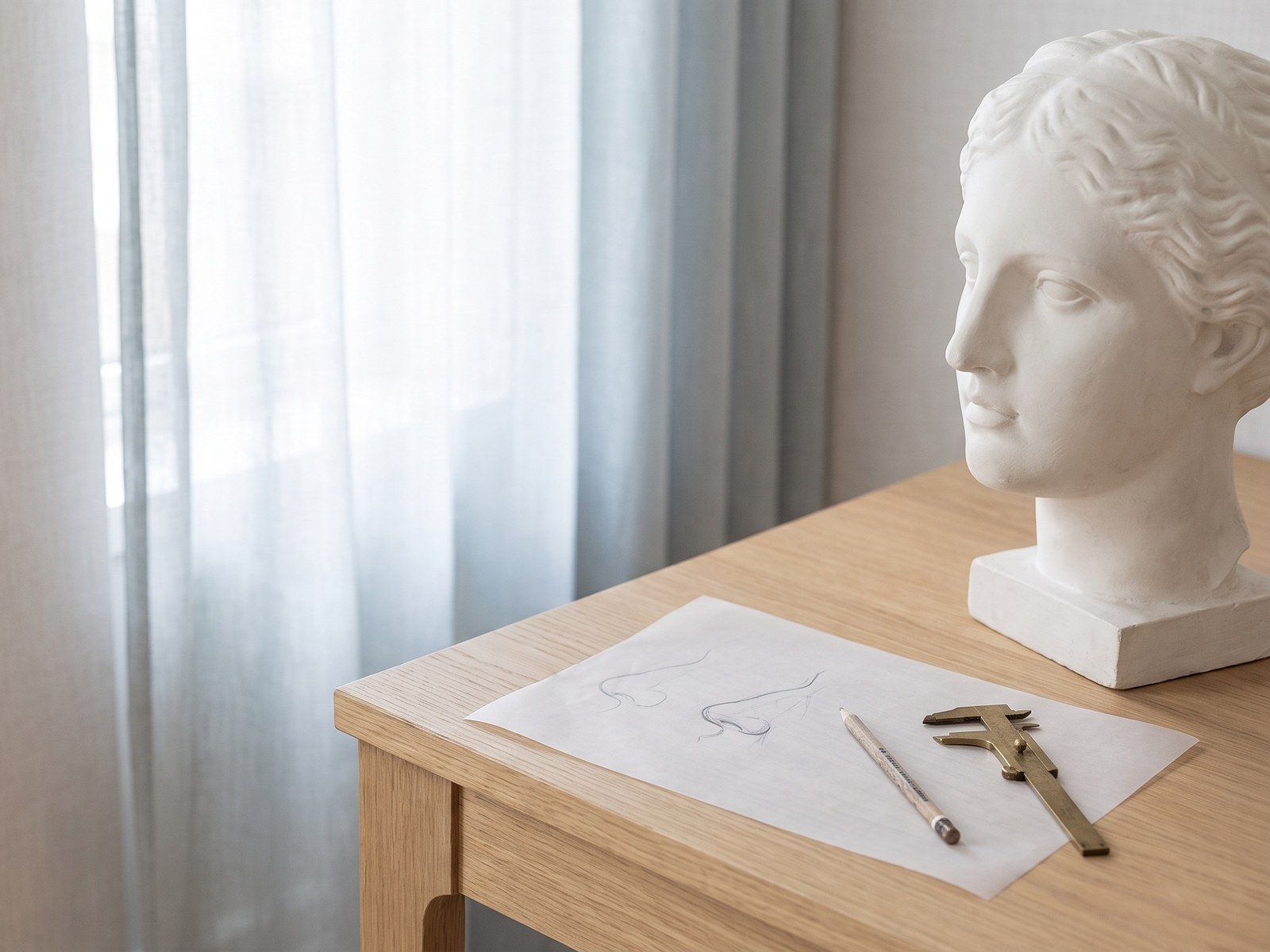
AI-generated image for illustrative purposes.
The nose is a feature where even small changes affect facial balance
Because the nose is in the center of the face, its shape and height can significantly alter your facial impression. Even subtle changes impact overall facial balance and facial contours.
When individuals feel their face lacks three-dimensional contour due to a low bridge or bulbous tip, they often consider rhinoplasty. For example, if a low nose makes the face appear flat, the mouth may appear relatively protruded.

Why You Shouldn't Aim Solely for a "Defined Nose and High Bridge"
Blindly approaching rhinoplasty with only "a defined nose and high bridge" in mind should be avoided. If rhinoplasty is performed without considering harmony with facial contours, the nose may not suit the face and can lead to revision surgery.
Therefore, calculating the balance between facial contours and facial features, choosing a surgical method suited to your facial shape is essential.
Here is the key point — Simply raising the nasal bridge high does not solve everything for a low nose.
Factors to Consider Alongside the Nasal Bridge
For natural harmony among facial features, not only bridge height but also the following five factors must be considered.
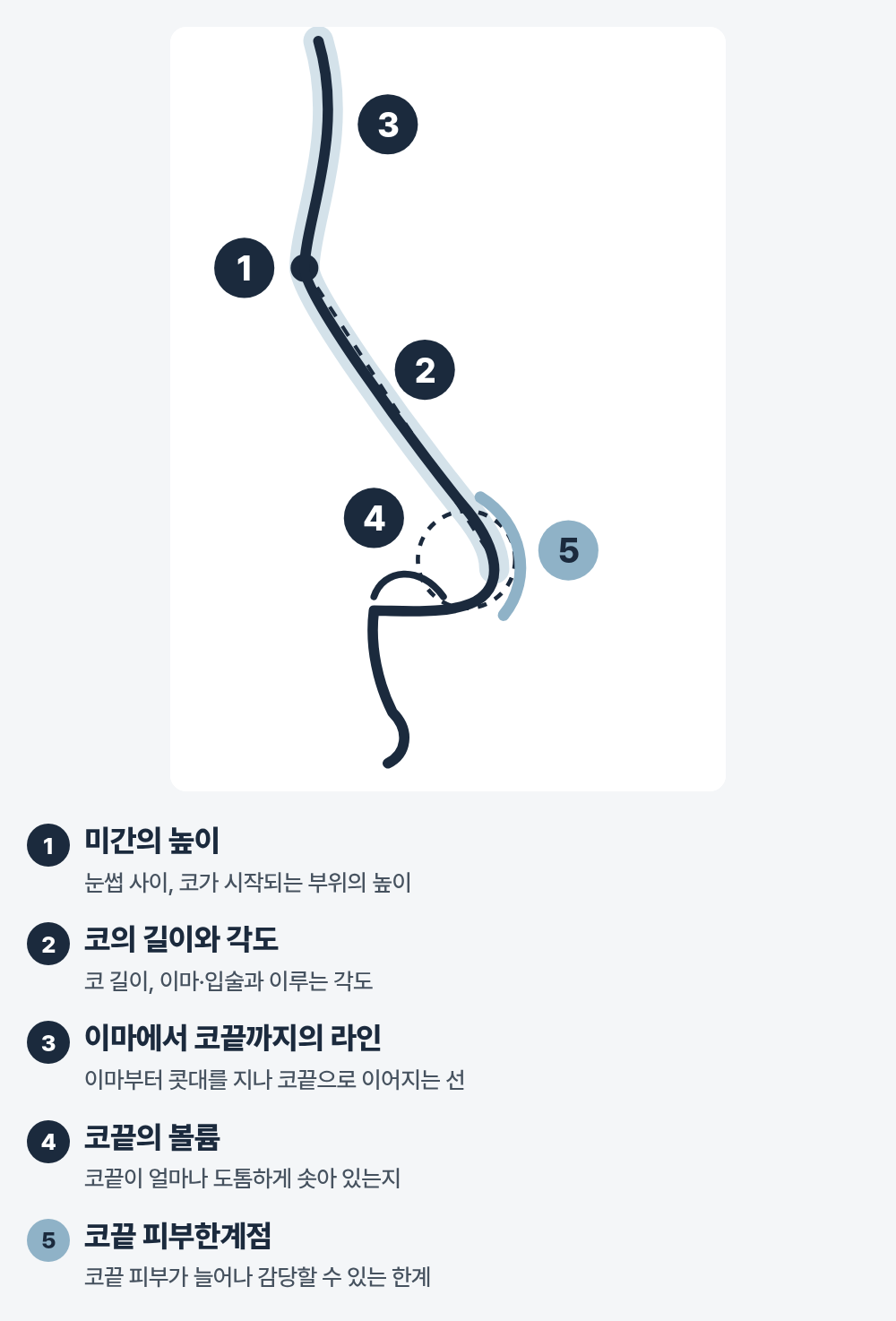
An illustration showing five factors evaluated alongside the nasal bridge on a profile view.
- Height between the eyebrows (radix) — The height where the nose begins between the eyebrows (radix)
- Nasal length and angle — Length from radix to nasal tip, and the angles formed with the forehead and lips
- Line descending from forehead to nasal tip — The line running from the forehead across the bridge to the nasal tip
- Nasal tip volume — How full and projected the nasal tip is
- Nasal tip skin limit — The limit to which nasal tip skin can stretch and accommodate
While there are well-known numerical values for ideal angles and heights, what matters more than numbers is overall facial harmony.
What is the nasal tip skin limit?
Nasal tip skin limit is a factor to consider alongside bridge height: how far the nasal tip skin can stretch, or the limit it can accommodate. Because skin thickness, elasticity, and the amount of nasal tip tissue vary from person to person, the same height can place undue strain on certain nasal tips.
If the nasal tip skin limit is not considered, the nose may take on the following shapes after rhinoplasty.
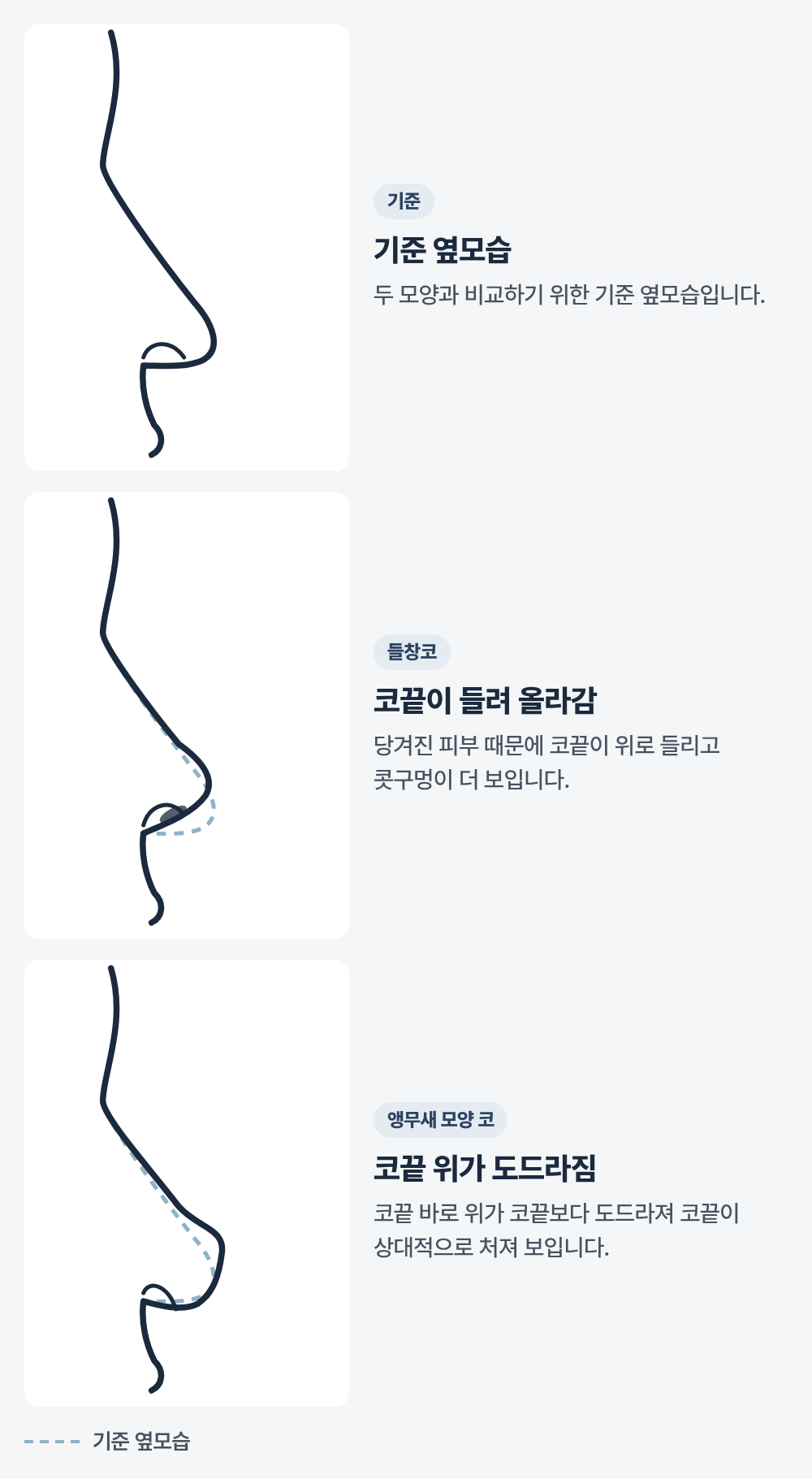
Two shapes that can occur when the skin limit is not considered. The faint dotted line is a baseline profile for comparison.
- Upturned nose — A nose where the nostrils are prominently visible from the front or the angle between the subnasale and upper lip is excessively wide; it can be congenital or caused by post-surgical tissue contraction. If the nasal tip skin limit is not considered, the pulled skin may elevate the tip, resulting in an upturned nose.
- Pollybeak deformity (parrot-beak nose) — A shape where the area immediately above the nasal tip protrudes more than the tip itself, making the tip appear relatively drooped. As the center of skin tension shifts and presses down on the bridge, a pollybeak deformity can develop.
Separately, if the skin is thin or sensitive, or if a thick implant is inserted, the implant may show through the skin. In addition, if the nasal tip cartilage is tied too tightly or if a small, thin-skinned tip is excessively raised, the nasal tip may appear pinched.
Order of assessment — That is why not only the bridge, but the entire line from the nasal tip to the bridge must be planned together. We also evaluate the condition of the nasal tip skin to discuss height and shape.
Why the Primary Surgery Is Crucial
“Because the nose runs through the center of the face, the primary surgery is extremely important. When aiming for natural facial harmony in rhinoplasty, one must approach it from various angles, including individual facial shape, underlying nasal framework, nasal length, nasal size, and nasal shape. Above all, complications such as postoperative inflammation, capsular contracture, and implant displacement can occur, so it is advisable to exercise the utmost caution and consult a board-certified specialist with extensive know-how and experience in rhinoplasty.” — Song Hyun-seok, Lead Surgeon
Open and Closed Approaches
Depending on the incision site, rhinoplasty is divided into Open and Closed Approaches. Which method is suitable depends on the extent of correction and the condition of the nose.
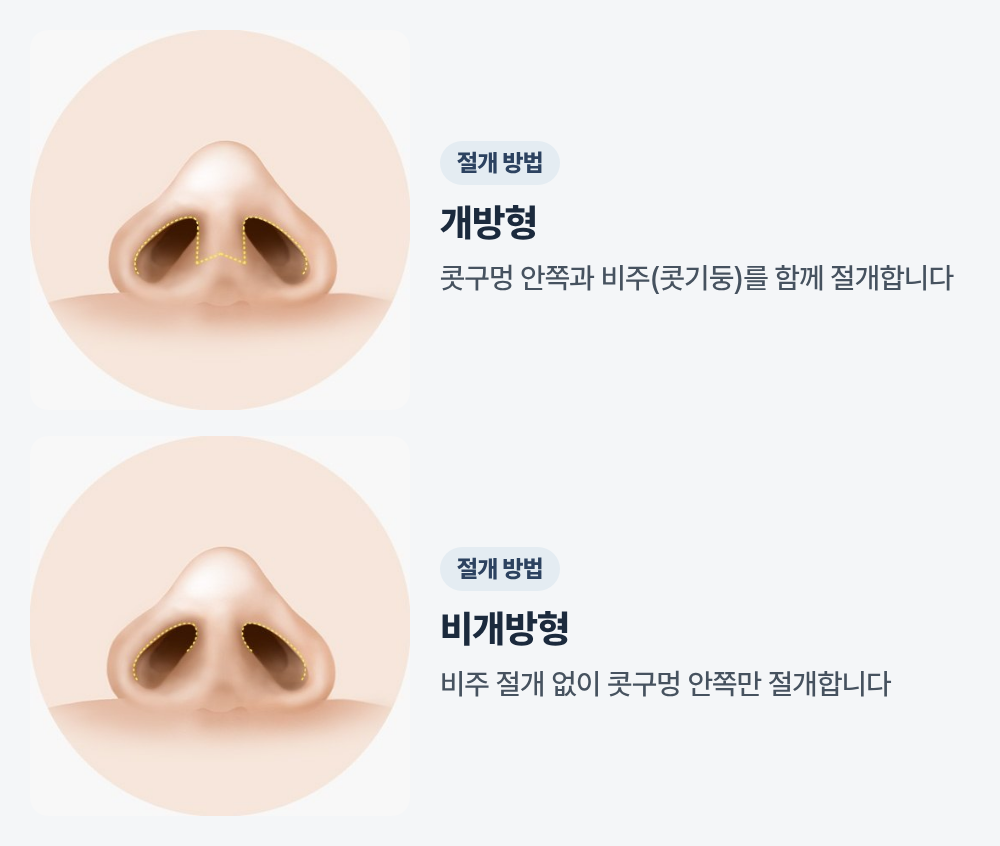
Incision lines according to surgical approach.
Open
- Incision site — Incisions made both inside the nostrils and across the columella
- Pros — Excellent surgical visibility allows clear confirmation of internal nasal structures and enables adjustments to both nasal height and length
- Cons — Visible external scarring may remain depending on the surgeon's skill and skin condition, and recovery takes longer than with the closed approach
- Indications — Overall rhinoplasty and revision rhinoplasty
Closed
- Incision site — Incision made only inside the nostrils
- Pros — No visible external scars because incision lines are placed entirely inside the nostrils
- Cons — Limited surgical visibility makes it difficult to assess internal nasal structures
- Indications — When the area of correction is limited, or when elevating only the bridge or tip with an implant alone
APEX Plastic Surgery's Low Nose Rhinoplasty standards. The actual method is determined after an examination.
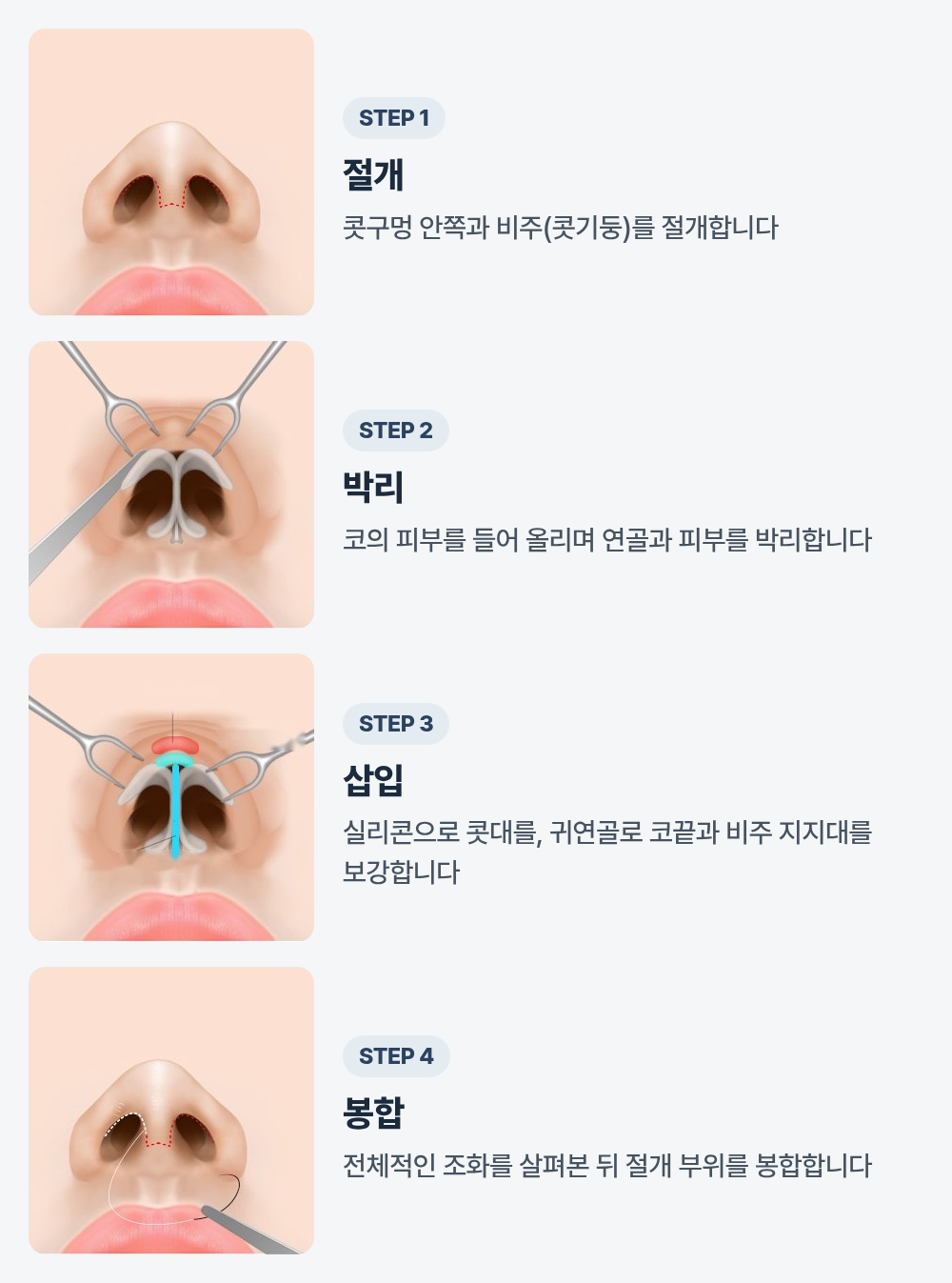
This is the open rhinoplasty procedure. Materials are based on low nose rhinoplasty standards (silicone for the bridge, ear cartilage for the tip and columellar strut) and may vary by individual.
Please keep in mind — Complications such as postoperative bleeding, infection, inflammation, capsular contracture (tissue hardening and tightening around the implant), and implant displacement or visibility may occur. Recovery and progress vary by individual. Precautions will be explained in detail during your consultation.
Frequently Asked Questions
Does raising only the nasal bridge fix a low nose?
Simply raising the bridge does not solve everything about a low nose. Factors such as radix height, nasal length and angle, the line descending from the forehead to the tip, nasal tip volume, and the nasal tip skin threshold must all be considered.
We evaluate the harmony between facial contours and features to choose the surgical method suited to your facial shape.
What is the nasal tip skin threshold?
It is a factor that must be considered alongside bridge height, referring to the limit to which the nasal tip skin can stretch and accommodate. Because skin thickness, elasticity, and the volume of tip tissue vary by individual, the same height may place excessive strain on certain nasal tips.
That is why we also evaluate the condition of the nasal tip skin when discussing height and shape.
What can happen if the skin threshold is not taken into account?
Tension from stretched skin can pull the tip upward into an upturned nose, or the center of skin tension can shift and compress the bridge, resulting in a pollybeak (parrot-beak) deformity.
This is why planning must address not only the nasal bridge, but the entire span from the nasal tip to the bridge.
How do open and closed rhinoplasty differ?
The open approach makes incisions both inside the nostrils and across the columella to operate while visualizing internal nasal structures; it allows for adjustments to nasal length as well, but external scarring may remain depending on skin condition, and recovery takes longer.
The closed approach makes incisions solely inside the nostrils; because surgical visibility is limited, it is used when the area requiring correction is not extensive.
What are the surgery and recovery times for low nose rhinoplasty?
APEX Plastic Surgery's Low Nose Rhinoplasty typically takes 1 hour 30 minutes to 2 hours under IV sedation, requires no hospitalization, with suture removal after 7 days, 2–3 follow-up clinic visits, and about 7–10 days of recovery. Surgery duration varies by procedure: approximately 1 hour 30 minutes for tip plasty, 2 hours to 2 hours 30 minutes for short/upturned nose rhinoplasty, and 2 hours 30 minutes to 3 hours for revision rhinoplasty.
This may vary depending on the patient's condition and surgical technique.
We Evaluate the Face and Nasal Tip Skin Before Bridge Height
What we examine first during consultation
- Facial shape — Harmony between facial contours and facial features
- Nasal framework — Fundamental structure of nasal bones and cartilage
- Nasal length, size, and shape — Current shape of the nose
- Radix and forehead-to-tip line — Starting height of the nose and the continuous line
- Nasal tip volume and skin — The range the skin can accommodate
- Desired nasal shape — Whether it harmonizes with the face and is realistically achievable
At APEX Plastic Surgery, board-certified plastic surgeon Dr. Song Hyun-seok provides all consultations and treatments.
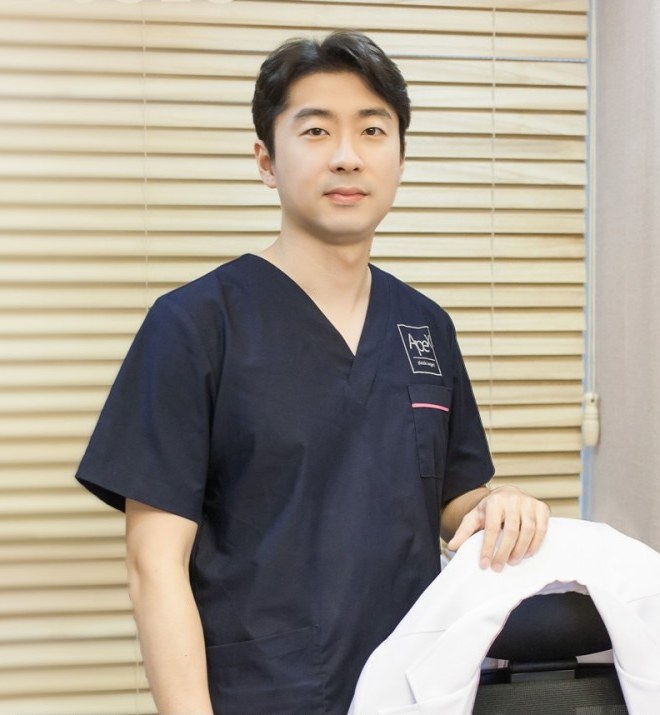
Song Hyun-seok, Head Director · Board-Certified Plastic Surgeon, Ph.D.
This post is intended for medical informational purposes only, does not guarantee specific treatment results, and does not replace a medical examination by a physician. The featured image is an AI-generated image (plaster bust) for illustrative purposes and does not depict a real person, and the profile line diagrams are explanatory illustrations. None of the images in this article are before-and-after comparison photos. Details such as surgery duration, anesthesia, and recovery time are based on the procedure guides on the APEX Plastic Surgery website and may vary depending on the individual. As general post-operative complications—such as bleeding, infection, and inflammation—may vary in severity from person to person, caution is required. Please ensure you receive thorough consultation, detailed explanations, and informed consent prior to surgery.
APEX CUSTOMER CENTER
Phone number :
02-3453-7907
Clinic Hours
Weekdays
AM 10 : 00 ~ PM 7 : 00
Saturday
AM 10 : 00 ~ PM 4 : 00
(Closed Sundays and holidays)
Subway Line 2, Yeoksam Station Exit 4, Hanjungang Building 3F
The two buildings are adjoined; please enter through the right-hand door.
(The right-hand building with KT on the 1st floor)
How do I make a reservation?
You can book by phone at our main number, 02-3453-7907.
Can I get a consultation in Japanese?
You can reach us via our official Instagram (@apexjapan_official) or X (@apex_surgery).
日本 SNS

Clinic Name : APEX Plastic Surgery
Address : 3F Hanjungang Bldg., 139-1 Teheran-ro, Gangnam-gu, Seoul (646-7 Yeoksam-dong)
CEO : Song Hyun-seok Business Registration No. : 220-10-15955 TEL : 02-3453-7907 FAX : 02-3453-7908
Copyright ⓒ 2026 APEX Plastic Surgery. ALL Rights Reserved.
Apex
[Summit, top]
APEX means ‘the summit,’ ‘the very top.’
with the finest medical technology and a systematized surgical process
our commitment to uncovering the hidden beauty unique to each patient
It embodies the spirit of APEX Plastic Surgery.


