APEX Column
APEX Column
Brought to you by APEX Plastic Surgery
Explore plastic surgery insights and stories.
Areola Reduction and Areolar Bump Removal: For Large Areolas, Start by Looking at Width and Borders
Date : 2026-11-19
Views : 27
In areola reduction, the incision location is determined by assessing how wide the areola is, whether the outer border is distinct, and the difference in color between the inner and outer areas. Small bumps around the areola are glands that protect the skin, so removal is considered when they are large or cause pain or itching.
The reasons an areola appears large vary from person to person. Some are naturally wide, while others enlarge or become asymmetrical after pregnancy and childbirth. Even with similarly large areolas, different conditions require different surgical methods, so here is a summary of what we evaluate and how we decide during a consultation.
AI-generated image for illustrative purposes.
Large Areolas: Size Is Evaluated in Proportion to the Entire Breast
There is no one-size-fits-all answer for areolar size. APEX Plastic Surgery provides guidance based on an average areolar diameter of 3.5–4.5 cm, with a central nipple diameter of about 1 cm and a height of about 0.7–1 cm. These figures are reference guidelines, and the actual extent of reduction is determined by evaluating them alongside breast size and shape, as well as nipple position.
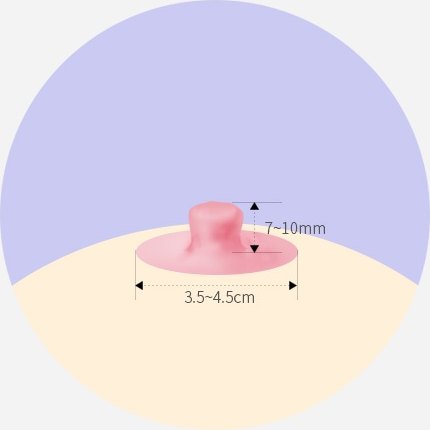
An explanatory diagram from the APEX Plastic Surgery website showing the average nipple-areola proportions.
Common reasons patients seek a consultation for areola reduction include:
- When the areola appears wide relative to the breast
- When the areola has enlarged after pregnancy and childbirth
- When the two areolas differ in size or shape
- When you wish to achieve an areola that harmonizes with your breast
Here is the key point — Areola reduction does not just focus on the desired size; the method is decided by collectively evaluating the width, border, color differences, and overall proportion to the breast.
Areola Reduction Surgical Methods: Two Incision Locations
Areola reduction is a procedure that reduces the diameter of the areola by designing a doughnut-shaped excision pattern, excising that tissue, and suturing the edges. The method is divided based on which border is excised.
- Incision around the nipple — Excises the inner areola adjacent to the nipple and sutures the surrounding skin toward the nipple. This is considered when the areola is not excessively wide and there is a significant color difference between the inner and outer areas.
- Periareolar incision — Excises the outer margin of the areola and sutures it. This is considered when the areola is very wide or the outer border is poorly defined.
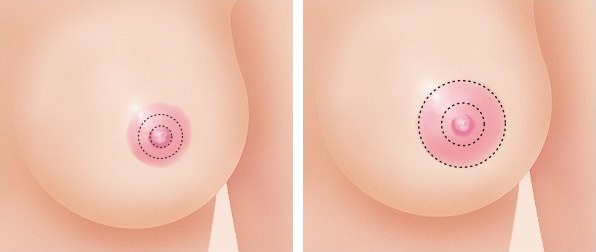
An illustration showing the planned excision area marked with dotted lines. The left shows the perinipple incision method, and the right shows the periareolar incision method. This is an explanatory diagram from the APEX Plastic Surgery website.
Because the incision line follows either the inner or outer border of the areola, where the scar will be situated is reviewed together before surgery. The rate and appearance of scar maturation vary from person to person.
Not All Areolar Bumps Need to Be Removed
The small, raised bumps around the areola are called Montgomery's glands or Montgomery's tubercles. They are normal structures that secrete an oily fluid to protect the areolar skin.
However, if secretions cannot discharge properly, the bumps may enlarge or become inflamed. Surgical removal is considered if a bump is excessively large or causes pain or itching. Bump removal is a procedure that excises a small bump and sutures it, which differs in scope from areola reduction that reduces the entire areola.
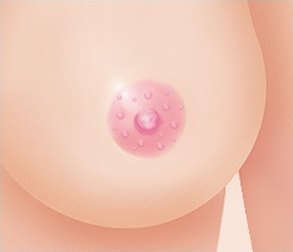
An illustration showing multiple raised Montgomery's tubercles on the areola. This is an explanatory diagram from the APEX Plastic Surgery website.
Even if the bumps bother you, do not squeeze or pick at them. If a bump becomes swollen or painful, have it evaluated during a consultation first.
Breastfeeding Plans, Sensation, and Scarring Are Checked Before Surgery
Beneath the areola run the milk ducts through which milk flows, as well as nerves that transmit sensation. APEX Plastic Surgery operates while taking these neural pathways into account to minimize sensory loss and ductal damage.
If you have future plans for pregnancy or breastfeeding, please let us know in advance during your consultation. Please also inform us if you have had prior breast surgery or are taking any medications.
Guidelines for areola reduction and bump removal are as follows:
- Surgery Duration — Within 1 hour
- Anesthesia — Local anesthesia or sedation
- Hospitalization — Not required
- Suture Removal — After 5–7 days
- Clinic Visits — 2–3 visits
- Recovery Period — About 1 week
APEX Plastic Surgery's Areola (Reduction / Bump Removal) These are general guidelines. They may vary depending on the patient's condition and the surgical method.
Even after suture removal, scarring and sensation continue to change for some time. You will receive guidance tailored to the extent of your surgery on how to wear undergarments and when to resume showering and exercise.
Please keep in mind — Complications such as bleeding, infection, inflammation, scarring, asymmetry, and sensory changes may occur after surgery. The extent and duration of recovery for scars and sensation vary from person to person. Specific precautions will be explained in detail during your consultation.
Frequently Asked Questions
How many centimeters should the areola be reduced to?
There is no single size that fits everyone. The average 3.5–4.5 cm is a reference guideline, and the extent of reduction is determined by evaluating it together with the size and shape of the breast and the size of the nipple.
Does the color of the areola also become lighter?
Areola reduction is a surgery to reduce the surface area of the areola. The difference in color between the inner and outer areas is considered when choosing the incision method, but how the color appears after surgery varies from person to person. You can receive an explanation tailored to your areola during your consultation.
Will I be unable to breastfeed after areola reduction?
The surgery is performed in a way that minimizes damage to the milk ducts, but the impact on breastfeeding can vary depending on the condition of the areola and milk ducts, as well as the extent of surgery. If you have plans to breastfeed in the future, please inform us before surgery to receive an explanation.
Can I also consult about large or inverted nipples at the same time?
For excessively large or elongated nipples, or inverted nipples that retract inward, Nipple (Inverted / Reduction) surgery can be discussed during consultation. Since the nipple and areola are seen together, if you have both concerns, having them examined together helps determine the method and sequence.
What precautions should I take during the recovery period?
Until the wound heals, avoid having underwear press firmly against or rub against the wound, and resume showering and exercising from the instructed time. If swelling or pain worsens, or if you feel heat, please contact the clinic.
Large areolas: the method is determined by assessing the width and border
What we examine first during consultation
- Width of the areola — How wide it is relative to breast size
- Border and color — Whether the outer border is distinct, and how the color differs between the inner and outer areas
- Asymmetry between sides — The size and shape of both areolas
- Nipple — Nipple size, degree of protrusion, and whether it is inverted
- Tubercles — Size of Montgomery's tubercles, and pain, itching, or inflammation
- Pregnancy and breastfeeding plans — Whether you have future plans
- Prior surgeries — Whether you have had previous breast surgery
At APEX Plastic Surgery, board-certified plastic surgeon Dr. Song Hyun-seok provides all consultations and treatments.

Song Hyun-seok, Head Director · Board-Certified Plastic Surgeon, Ph.D.
This post is intended to provide medical information and does not guarantee specific treatment outcomes or replace medical examination by a physician. The featured image is an AI-generated image to aid understanding, and the nipple-areola ratio diagram, areola reduction design diagram, and areola tubercle diagram are informational images from the APEX Plastic Surgery website. None of the images in the text are before-and-after comparison photos. Surgery duration, anesthesia, stitch removal, and recovery periods are standard guidelines for each procedure from the APEX Plastic Surgery website and may vary depending on the individual. Caution is advised as common side effects that may occur after surgery, such as bleeding, infection, and inflammation, can vary in degree depending on the individual. Please ensure you receive thorough consultation, explanation, and consent prior to surgery.
Medical review: Song Hyun-seok, Director (Board-Certified Plastic Surgeon) · 2026.11.13
APEX CUSTOMER CENTER
Phone number :
02-3453-7907
Clinic Hours
Weekdays
AM 10 : 00 ~ PM 7 : 00
Saturday
AM 10 : 00 ~ PM 4 : 00
(Closed Sundays and holidays)
Subway Line 2, Yeoksam Station Exit 4, Hanjungang Building 3F
The two buildings are adjoined; please enter through the right-hand door.
(The right-hand building with KT on the 1st floor)
How do I make a reservation?
You can book by phone at our main number, 02-3453-7907.
Can I get a consultation in Japanese?
You can reach us via our official Instagram (@apexjapan_official) or X (@apex_surgery).
日本 SNS

Clinic Name : APEX Plastic Surgery
Address : 3F Hanjungang Bldg., 139-1 Teheran-ro, Gangnam-gu, Seoul (646-7 Yeoksam-dong)
CEO : Song Hyun-seok Business Registration No. : 220-10-15955 TEL : 02-3453-7907 FAX : 02-3453-7908
Copyright ⓒ 2026 APEX Plastic Surgery. ALL Rights Reserved.
Apex
[Summit, top]
APEX means ‘the summit,’ ‘the very top.’
with the finest medical technology and a systematized surgical process
our commitment to uncovering the hidden beauty unique to each patient
It embodies the spirit of APEX Plastic Surgery.


