APEX Column
APEX Column
Brought to you by APEX Plastic Surgery
Explore plastic surgery insights and stories.
Dark Circles: Look at the Cause Before Concealing — Under-Eye Fat Repositioning When Under-Eye Fat Is the Cause
Date : 2026-10-07
Views : 177
Dark circles refer to a dark, shadowy appearance under the eyes that can dull your complexion and make your face look tired. However, dark circles do not have just one cause, so the appropriate approach varies depending on the underlying cause. Here, we explain why dark circles develop, what under-eye fat repositioning involves when under-eye fat is the cause, and how a transconjunctival approach differs from an incision through the skin.

AI-generated image for illustrative purposes.
Dark circles do not have just one cause
Causes of dark circles include the following, and among them, cases caused by protruding under-eye fat are generally considered the most common.
- Thin skin — When the skin is thin, allowing the underlying muscle to show through.
- Pigmentation and skin tone — When there is pigmentation within the skin itself or the skin tone appears dark.
- Under-eye fat protrusion — When the orbital septum supporting the fat beneath the eyes weakens, causing fat to bulge forward.
This article covers Transconjunctival Fat Repositioning, a procedure for dark circles caused by protruding under-eye fat. Therefore, if you have dark circles, identifying the underlying cause should be the first step.
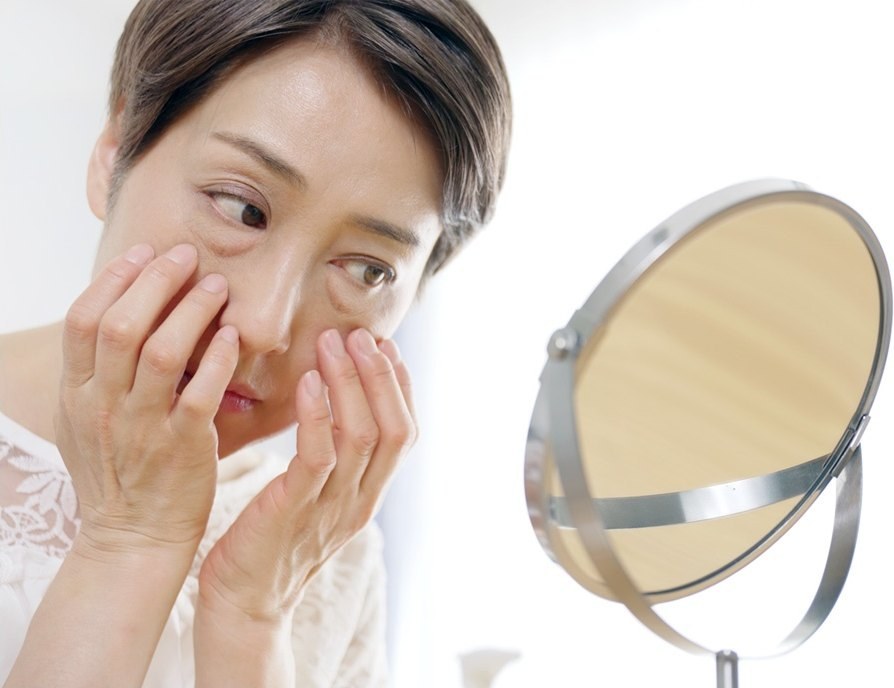
Why do shadows form when under-eye fat bulges?
Under-eye fat is naturally positioned around the eyeball to cushion it from impact. When the orbital septum supporting this fat weakens or the under-eye muscles and skin lose elasticity, the orbital fat and septum bulge forward, casting a shadow beneath the protrusion.
Additionally, orbital fat can push the muscle toward the skin, causing the skin tone to appear dark reddish as the muscle shows through.
There are largely two reasons why under-eye fat protrudes: when the underlying bone supporting the fat is congenitally recessed, causing the fat to bulge downward, and when the fat pads lose support with age, allowing the fat to sag forward and protrude.

These are common under-eye changes by age group. Even at the same age, they vary from person to person.
Here is the key point — In this case, the shadow beneath the protruding fat and the hollow of the sunken groove can both contribute to the dark appearance under the eyes.
What kind of surgery is under-eye fat repositioning?
Under-eye fat repositioning is a surgery that balances under-eye fat. By shifting protruding fat into the sunken tear trough, it addresses both the bulging and hollow areas together.

This is the transconjunctival under-eye fat repositioning process. The actual surgical plan is determined after an in-person consultation.
- Transconjunctival Incision — An incision is made in the conjunctiva on the inside of the eyelid.
- Dissection of the tear trough area — The sunken tear trough area is dissected to create space for fat repositioning.
- Fat repositioning — Protruding fat is moved into the sunken area.
- Septal reinforcement and fat fixation — The repositioned fat is secured and the orbital septum is reinforced.
Protruding fat is either repositioned into sunken areas or removed. If excessive fat is removed, complications such as under-eye hollowing can occur, and there is also a risk of recurrence where fat protrudes again; therefore, whether to reposition or remove fat and how much to address is determined after an examination.
Transconjunctival Approach or Skin Incision?
In dark circle surgery, the degree of skin laxity usually determines the surgical approach. At APEX Plastic Surgery, Transconjunctival Fat Repositioning and skin-incision Lower Blepharoplasty are distinguished as two separate procedures.
Transconjunctival Approach — Transconjunctival Under-Eye Fat Repositioning
- Primary indications — When skin laxity is minimal
- Incision location — Conjunctiva on the inside of the lower eyelid
- Primary candidates — Patients in their 20s and 30s with good skin elasticity
- Surgical scope — Relatively limited
- Skin removal — Skin removal not possible even if sagging is severe
- Incision line — Not visible externally
Skin Incision — Lower Blepharoplasty
- Primary indications — When significant skin laxity requires addressing both excess skin and the orbicularis oculi muscle
- Incision location — Skin incision along the lower lash line extending to the outer corner of the eye
- Primary candidates — Patients in their 40s to 60s with reduced skin elasticity
- Surgical scope — Allows for extensive correction
- Skin removal — Excess skin can be removed even with severe sagging
- Incision line — Remains along the lower lash line
The actual method is determined after an examination.
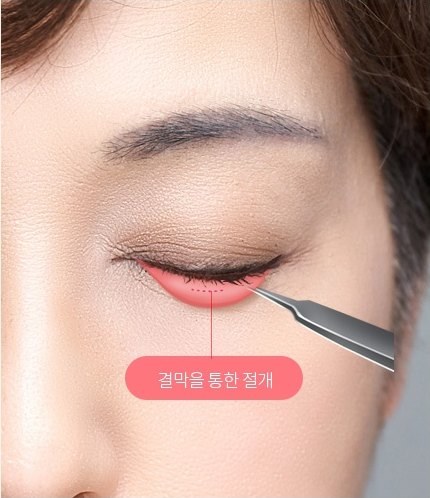
Incision location through the conjunctiva.
While approaching through the conjunctiva leaves no externally visible incision line, the surgical scope is relatively limited, and excess skin cannot be removed if sagging is severe. Because lower blepharoplasty involves incising the skin along the lower lash line to address fat, excising some sagging skin and muscle, and then suturing, an incision line (scar) remains. The incision is made close to the eyelashes to minimize visible scarring.
Please keep in mind — complications such as bleeding, infection, and inflammation may occur after surgery, excessive fat removal may cause under-eye hollowing, and recurrence is possible. Lower blepharoplasty involving a skin incision leaves an incision line. Swelling and recovery progress vary by individual, and precautions will be explained in detail during the consultation.
The under-eye area is thin and delicate
“Under-eye fat repositioning varies depending on the patient's age, degree of skin laxity, and extent of orbital fat protrusion. Because it is a surgery performed on the thin, delicate skin layer under the eyes, it is important to carefully consider the procedure after consulting with a board-certified plastic surgeon with extensive experience and expertise.” — Song Hyun-seok, Lead Surgeon
Even for dark circles, depending on factors such as age, skin laxity, and the degree of fat protrusion, the surgical approach may vary. During your consultation, be sure to check the following points together.
- Cause of dark circles — Whether it is caused by fat protrusion and shadows, or skin tone and thin skin
- Degree of fat protrusion and tear trough — How much it protrudes and where it is hollowed
- Degree of skin laxity — Whether a transconjunctival approach is suitable or a skin incision is needed
- Recovery timeline — Surgery duration, stitches, number of clinic visits, and swelling
- Complications and risk of recurrence — Possible complications, recurrence, and incision lines
Frequently Asked Questions
Can all dark circles be improved with under-eye fat repositioning?
Causes of dark circles include thin skin showing underlying muscle, pigmentation or dark skin tone, and protruding fat due to a weakened orbital septum. Under-eye fat repositioning specifically addresses dark circles caused by protruding under-eye fat.
That is why identifying the cause comes first.
Is under-eye fat repositioning a surgery to remove fat?
It is a procedure that repositions bulging fat into the hollow tear trough, and in some cases, fat may also be removed.
Excessive fat removal can cause complications such as under-eye hollowing and may lead to recurrence, so whether to reposition or remove fat—and how much to treat—is determined after examination.
Does it leave visible scars?
Transconjunctival under-eye fat repositioning makes an incision inside the conjunctiva of the lower eyelid, leaving no externally visible incision line. However, the surgical scope is relatively limited, and excess skin cannot be removed if sagging is severe.
Lower blepharoplasty involves an incision along the lower lash line, leaving an incision line (scar). The incision is placed close to the eyelashes to minimize visible scarring.
How do the under-eyes change with age?
Generally, in one's 20s, orbital fat pushes forward, making the under-eyes look puffy; in the 30s, fat protrudes further while tear troughs appear sunken; in the 40s, fat sags and tear troughs become pronounced; and in the 50s, skin discoloration along the tear troughs often creates a tired appearance.
Even at the same age, changes vary from person to person.
What are the surgery duration and recovery period?
APEX Plastic Surgery's Transconjunctival Fat Repositioning takes less than 1 hour under local or sleep anesthesia, requires no hospitalization or stitch removal, involves 1–2 clinic visits, and has a recovery period of about 1 week. Skin-incision Lower Blepharoplasty takes about 1 hour under local or sleep anesthesia, with stitches removed after 5 days, 1–2 clinic visits, and a recovery period of about 5–7 days.
This may vary depending on the patient's condition and surgical technique.
Look at the cause of under-eye shadows before trying to conceal them
What we examine first during consultation
- Cause of dark circles — Whether it is due to fat protrusion, skin color, or thin skin
- Age — Common under-eye changes by age group
- Volume and location of under-eye fat — How much and where it protrudes
- Tear troughs — Where and how deeply they are sunken
- Skin laxity — Whether a transconjunctival approach or skin incision is appropriate
- Wrinkles — Severity of under-eye wrinkles
At APEX Plastic Surgery, board-certified plastic surgeon Dr. Song Hyun-seok provides all consultations and treatments.

Song Hyun-seok, Head Director · Board-Certified Plastic Surgeon, Ph.D.
This post is intended to provide medical information and does not guarantee specific treatment outcomes or substitute for a professional medical consultation. The representative image is an AI-generated still-life image that does not feature any person. None of the images in this article are before-and-after comparison photos. Information regarding surgery duration, anesthesia, and recovery period is based on the procedure guides on the APEX Plastic Surgery website and may vary depending on the individual. Potential complications that may generally occur after surgery, such as bleeding, infection, and inflammation, can vary in severity by individual, requiring caution; excessive fat removal may cause under-eye hollowing or recurrence. Please ensure you receive a thorough consultation, detailed explanation, and provide informed consent prior to surgery.
APEX CUSTOMER CENTER
Phone number :
02-3453-7907
Clinic Hours
Weekdays
AM 10 : 00 ~ PM 7 : 00
Saturday
AM 10 : 00 ~ PM 4 : 00
(Closed Sundays and holidays)
Subway Line 2, Yeoksam Station Exit 4, Hanjungang Building 3F
The two buildings are adjoined; please enter through the right-hand door.
(The right-hand building with KT on the 1st floor)
How do I make a reservation?
You can book by phone at our main number, 02-3453-7907.
Can I get a consultation in Japanese?
You can reach us via our official Instagram (@apexjapan_official) or X (@apex_surgery).
日本 SNS

Clinic Name : APEX Plastic Surgery
Address : 3F Hanjungang Bldg., 139-1 Teheran-ro, Gangnam-gu, Seoul (646-7 Yeoksam-dong)
CEO : Song Hyun-seok Business Registration No. : 220-10-15955 TEL : 02-3453-7907 FAX : 02-3453-7908
Copyright ⓒ 2026 APEX Plastic Surgery. ALL Rights Reserved.
Apex
[Summit, top]
APEX means ‘the summit,’ ‘the very top.’
with the finest medical technology and a systematized surgical process
our commitment to uncovering the hidden beauty unique to each patient
It embodies the spirit of APEX Plastic Surgery.


