APEX Column
APEX Column
Brought to you by APEX Plastic Surgery
Explore plastic surgery insights and stories.
Revision Rhinoplasty: Causes, Timing, and What to Check Before Your Primary Rhinoplasty
Date : 2026-11-03
Views : 43
Revision rhinoplasty is considered when an implant becomes crooked, mobile, or visible, when the nasal tip turns upward due to capsular contracture, or when the tip droops or appears pinched. These issues are related to implant size and placement, skin thickness, and the structural support of the nasal tip. That is why it is essential to check these three factors in advance during your primary rhinoplasty consultation.
The nose contains abundant cartilage and can be affected by the movement of facial muscles, requiring delicate surgery that addresses both aesthetic appearance and breathing function. In revision surgery, the surgeon must additionally manage scar tissue and capsules formed after previous procedures, along with previously used implants and cartilage. Here is an overview of the causes of revision rhinoplasty, the ideal timing for revision, and key points to verify during your primary rhinoplasty consultation.

AI-generated image for illustrative purposes.
When Revision Rhinoplasty Is Considered
At APEX Plastic Surgery, revision rhinoplasty is typically considered in the following cases:
- When the implant shifts or becomes visible
- When the nasal bridge or tip has turned red
- When revision is needed due to complications such as infection or capsular contracture (hardening and contracture of tissue around the implant)
- If you are unsatisfied with a previous surgery
- When the bridge is crooked after rhinoplasty
While causes vary, a major contributing factor is undergoing surgery without thorough consultation. This often leads patients to consider revision when the outcome differs from the desired nasal shape, the implant is placed too high or shifts, or inflammation develops.
Six Common Causes of Revision Rhinoplasty
Below are representative cases requiring revision rhinoplasty and their causes:
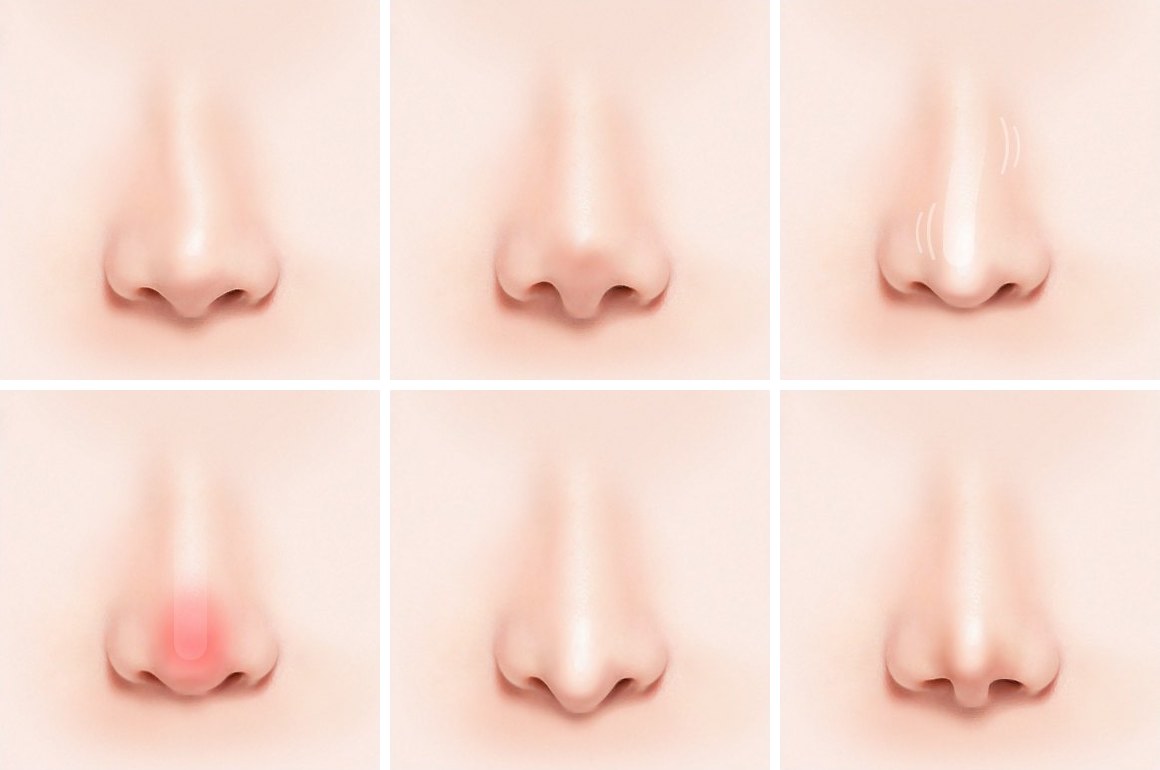
From top left: crooked implant, upturned and shortened tip (contracture), mobile implant, visible implant, drooping tip, and pinched tip.
- When the implant looks crooked — Occurs when the undersurface of the implant resting on the nasal bone does not match the nasal contour and tilts to one side, or when the implant is too long relative to the length of the nose.
- Upturned and shortened nasal tip (contracture) — A condition where the nose contracts upward and hardens as capsules and scar tissue adhere around the implant following postoperative infection or repeated surgeries.
- When the implant shifts — Occurs when the implant fails to settle securely between the nasal bone and periosteum (the thin membrane covering bone).
- When the implant shows through — When a thick implant is placed beneath thin or sensitive skin, the contour of the silicone implant or cartilage grafted to the tip becomes visibly prominent through the skin.
- Drooping nasal tip — If the support structure for the tip cartilage is weak and the columella (the pillar between the nostrils) is short, the nasal tip can droop over time.
- Pinched nasal tip — Can occur when the tip cartilage is tied too tightly during surgery, or when a small, thin-skinned tip is elevated excessively.
Tracing the Causes Reveals What to Verify in Primary Surgery
These six causes can be categorized into implant size and placement, the elevation height your skin can tolerate, and the structural support of the nasal tip—along with postoperative infection management. Tailoring these factors to your individual nasal anatomy during your primary rhinoplasty is the best way to prevent the need for revision surgery.
Implant Size and Placement
The implant must conform to the shape of the nasal bone and nasal length, and it should be positioned securely above the nasal bone and beneath the periosteum covering the bone. If the implant fails to seat securely in this pocket, it may shift or become mobile.
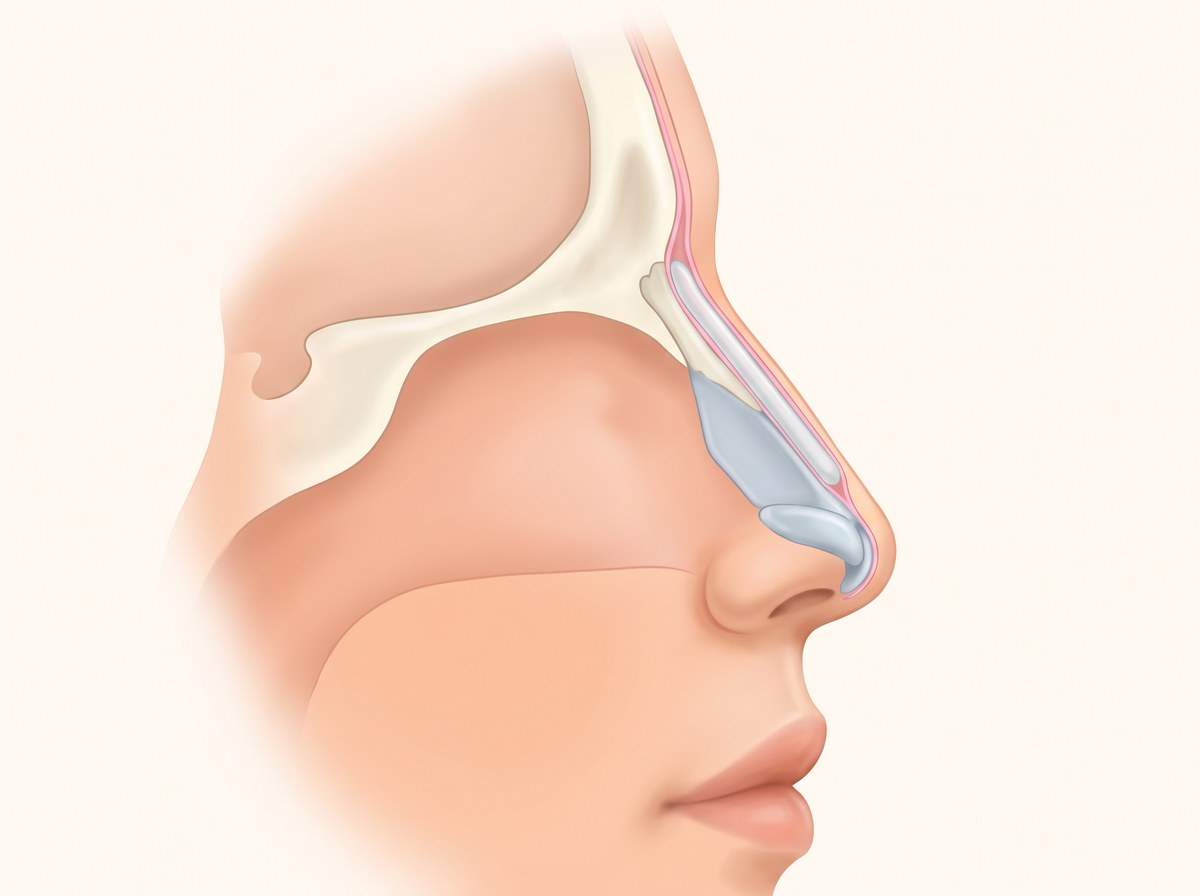
This cross-sectional diagram illustrates the position of the dorsal implant from the side. White represents the implant, the pink line is the periosteum, ivory represents the nasal bone, and bluish-gray is cartilage. This is an AI-generated illustration for explanatory purposes.
If an implant is longer than the nasal bridge or its base does not conform to the nasal bone, it can tilt to one side and appear crooked. Therefore, during consultation, the surgeon examines the shape of the nasal bone and nasal length to determine the appropriate implant length and contour.
Elevation Height the Skin Can Tolerate
If a thick implant is placed beneath thin or sensitive skin, the implant may become visible, or the nasal tip may look pinched. Rather than focusing solely on the desired height, it is essential to assess whether your nasal skin can adequately accommodate that height. This criterion is covered in our Nasal Tip Skin Limit Column in detail. In cases of thin skin, reinforcing with fascia or using autologous tissue is also considered, as outlined in our No-Implant Rhinoplasty Column.
Structural Support of the Nasal Tip
If the support structure for the tip cartilage is weak and the columella is short, the nasal tip can droop over time. Conversely, tying the tip cartilage too tightly can cause the tip to appear pinched. Therefore, the surgeon evaluates the size and strength of the tip cartilage along with columellar length to decide how to support the nasal tip.
Postoperative Inflammation Management
Postoperative infection can lead to capsular contracture. If unusual changes occur, such as worsening swelling or redness, it is best to seek prompt evaluation at the clinic where your surgery was performed.
Here is the key point — Looking at the causes of revision rhinoplasty in reverse, it is crucial in primary rhinoplasty to customize implant size and placement, tolerable skin height, and tip support to your individual nasal anatomy.
Timing and Surgical Method Are Determined by the Underlying Cause
Revision rhinoplasty is generally recommended at least 6 months after the initial surgery, once tissues have softened sufficiently. If infection has occurred, the inserted implant is removed first, and revision surgery is performed only after confirming that the inflammation has completely subsided.
Surgical methods for revision vary depending on the cause.
- When the implant appears crooked — The existing implant is removed, sufficient pocket space is created for a new implant, and an appropriately contoured implant is placed.
- When the nasal tip is upturned due to contracture — The contracture causing the upward pull is released, internal nasal tissues are thoroughly dissected, and the tip is corrected and stabilized using septal or ear cartilage.
- When the implant is mobile — The position is corrected so that the implant rests securely beneath the periosteum.
- When the implant is visible through the skin — We replace it with an implant of appropriate thickness or cover it with autologous fascia.
- When the nasal tip droops — We elevate the nasal tip by extending the nasal septum or reinforcing the columella.
- When the nasal tip looks pinched — We reposition the tip cartilage or graft cartilage to spread it out, and may also reinforce the surrounding tip area with a dermis graft.
In revision surgery, scar tissue and capsules formed from previous surgery must also be addressed, and available surgical options vary depending on the amount and condition of remaining cartilage. Therefore, we first verify what materials were used in the previous surgery.
APEX Plastic Surgery's Revision Rhinoplasty guidelines. The actual method is determined after examination.
Please keep in mind — Even after revision surgery, complications such as bleeding, infection, inflammation, scarring, asymmetry, nasal obstruction, resorption or deformation of grafted cartilage, and contracture may occur. If tissues have hardened or little cartilage remains from previous surgery, the correctable range may be limited. Swelling, bruising, and the recovery process and progress vary by individual. Specific precautions will be explained in detail during your consultation.
For the nose, harmony with the face comes before height
“Because the nose is located at the center of the human face, it plays a major role in shaping one's impression, and since even small changes have a significant impact on the overall image, harmony is essential to achieve a balanced, natural look. If one merely focuses on heightening the nose without considering facial shape, nasal contours, and overall harmony, this balance can be broken, making the face look harsh or unnatural.” — Song Hyun-seok, Chief Medical Director
Questions to ask during your primary rhinoplasty consultation
To anticipate the causes of revision rhinoplasty in advance, please ask the following questions and listen carefully to the explanations during your initial consultation.
- Skin thickness — Whether the nasal skin can handle the desired height
- Implant — If an implant is used, what material, what length and height, and where it will be placed
- Tip support method — The strength of the tip cartilage, and what material or technique will be used to support the tip
- Breathing — Whether functional issues such as a deviated nose or nasal obstruction are also present
- Postoperative follow-up care — When and how to receive medical care if unusual changes or symptoms occur
- Previous surgical records — If undergoing revision surgery, whether you know the previously used implants, cartilage, and surgery date
Frequently Asked Questions
When can revision rhinoplasty be performed?
It is best to proceed after at least 6 months have passed since surgery, once tissues have softened overall. If inflammation has occurred, the implant should be removed first, and revision surgery is performed after confirming that the inflammation has resolved.
The bridge or tip of my nose has turned red. Do I need revision surgery?
Redness on the nasal bridge or tip is also a reason to consider revision rhinoplasty. We first examine the condition of the implant and skin and check for inflammation to identify the underlying cause.
Does the implant always have to be removed during revision surgery?
It depends on the cause. Options include replacing the implant with one that matches your anatomy, repositioning it beneath the periosteum, or covering it with autologous fascia. If inflammation has developed, the implant is removed first.
The approach using autologous tissue without silicone is No-Implant Rhinoplasty Column.
My nasal tip is upturned and shortened. Can it be corrected?
If the tip is upturned due to contracture, the contracting scar tissue is released, internal nasal tissues are thoroughly dissected, and the tip is corrected and anchored using septal cartilage or ear cartilage. The extent of correction may vary depending on tissue firmness and remaining cartilage, which is determined following an examination.
What are the surgery duration and recovery period?
At APEX Plastic Surgery, revision rhinoplasty typically involves a surgical time of 2 hours 30 minutes to 3 hours, twilight sedation, no hospitalization, suture removal after 7 days, 2–3 follow-up visits, and a recovery period of approximately 7–10 days. These may vary depending on patient condition and surgical technique.
Evaluating your nose's unique anatomical conditions right from primary rhinoplasty
What we examine first during consultation
- Skin thickness — Whether the implant could show through the skin, and whether the skin can handle the desired height
- Nasal bone and nasal length — Whether the implant's length and shape are a proper fit
- Tip cartilage and columella — Whether there is sufficient structural support for the nasal tip
- Breathing — Whether nasal obstruction or a deviated nose is also present
- Prior surgeries — Use of implants/cartilage, history of inflammation/contracture, and surgery date
- Facial harmony — Whether the nose harmonizes with the facial shape and features
At APEX Plastic Surgery, board-certified plastic surgeon Dr. Song Hyun-seok provides all consultations and treatments.
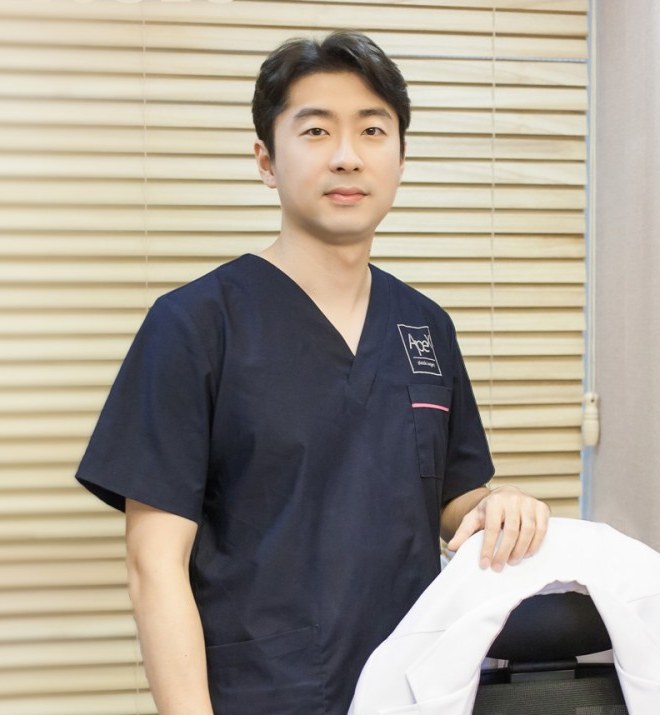
Song Hyun-seok, Head Director · Board-Certified Plastic Surgeon, Ph.D.
This post is intended solely for medical informational purposes, does not guarantee specific treatment outcomes, and is not a substitute for diagnosis by a medical professional. The featured image and nasal cross-section diagram are AI-generated images to assist understanding, and the revision rhinoplasty case illustrations are diagrams for explanatory purposes. None of the images in this article are before-and-after comparison photos. Operating times, anesthesia types, and recovery periods are based on general surgery guidelines on the APEX Plastic Surgery website and may vary by individual. As common complications such as postoperative bleeding, infection, and inflammation may vary in severity from person to person, caution is required. Please ensure thorough consultation, explanation, and informed consent before surgery.
APEX CUSTOMER CENTER
Phone number :
02-3453-7907
Clinic Hours
Weekdays
AM 10 : 00 ~ PM 7 : 00
Saturday
AM 10 : 00 ~ PM 4 : 00
(Closed Sundays and holidays)
Subway Line 2, Yeoksam Station Exit 4, Hanjungang Building 3F
The two buildings are adjoined; please enter through the right-hand door.
(The right-hand building with KT on the 1st floor)
How do I make a reservation?
You can book by phone at our main number, 02-3453-7907.
Can I get a consultation in Japanese?
You can reach us via our official Instagram (@apexjapan_official) or X (@apex_surgery).
日本 SNS

Clinic Name : APEX Plastic Surgery
Address : 3F Hanjungang Bldg., 139-1 Teheran-ro, Gangnam-gu, Seoul (646-7 Yeoksam-dong)
CEO : Song Hyun-seok Business Registration No. : 220-10-15955 TEL : 02-3453-7907 FAX : 02-3453-7908
Copyright ⓒ 2026 APEX Plastic Surgery. ALL Rights Reserved.
Apex
[Summit, top]
APEX means ‘the summit,’ ‘the very top.’
with the finest medical technology and a systematized surgical process
our commitment to uncovering the hidden beauty unique to each patient
It embodies the spirit of APEX Plastic Surgery.


