APEX Column
APEX Column
Brought to you by APEX Plastic Surgery
Explore plastic surgery insights and stories.
Difference Between Ptosis Correction and Double Eyelid Surgery, For Sleepy Eyes, We Look at Eye-Opening Strength First
Date : 2026-10-13
Views : 20
Ptosis correction is a surgery that reinforces the strength of the muscles that open the eyes so that the eyelids lift sufficiently, while double eyelid surgery creates a line where the skin folds when opening the eyes. Even for sleepy-looking eyes, the right surgery differs depending on whether the cause is the muscle or the skin.
When told that their eyes look small or sleepy, people often think of double eyelid surgery first. However, while in some cases eyelid skin sags down to cover the eyes, in other cases, weak eye-opening muscles prevent the eyelids from lifting sufficiently. Here is an overview of how the two surgeries differ, how the surgical method is chosen, and what is evaluated during a consultation.

AI-generated image for illustrative purposes.
Eye Shape Greatly Influences First Impressions
The eyes play an important role in determining first impressions and overall image. Eyes that look sleepy or intimidating can lead to misunderstandings about one's personality, regardless of one's actual character.
That is why eye surgery has long been considered by many. However, choosing a procedure without careful consideration can result in an unnatural look that lacks harmony with the rest of the face. In some cases, complications can even lead to revision surgery.
Ptosis Correction Reinforces “Eye-Opening Strength”
Ptosis correction is another term for blepharoptosis repair. It is performed when the muscles that open the eyes—the levator palpebrae superioris or Müller's muscle—are congenitally or acquiredly weak, preventing the upper eyelid margin from lifting to a normal height when opening the eyes.
When weak eye-opening muscles cause the eyelid to droop and cover 2 mm or more of the pupil, it is referred to as ptosis (blepharoptosis). When ptosis is present, much of the pupil is covered, easily giving a sleepy or tired impression, and patients often excessively engage their forehead muscles to open their eyes.
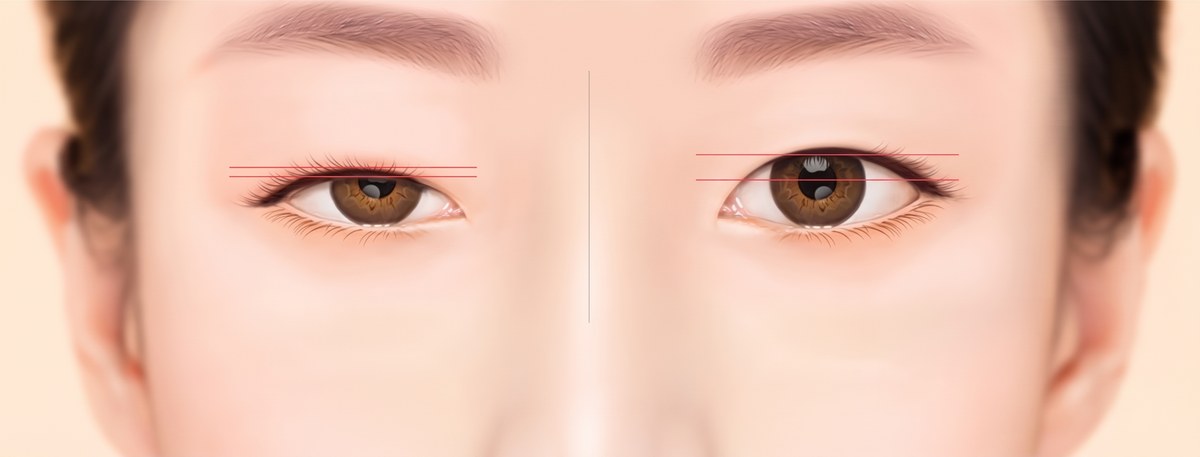
On the left is an eye where the eyelid covers much of the pupil; on the right is an eye where the pupil is sufficiently exposed. If the distance from the center of the pupil to the eyelid margin is within 2 mm, ptosis correction is considered; approximately 5 mm is regarded as normal range. This is an AI-generated illustration for explanatory purposes.
Not Everyone Who Looks Sleepy Needs Ptosis Correction
Just because your eyes are small or your forehead tenses when opening them does not mean everyone needs ptosis correction. First, it is essential to distinguish whether the issue is caused by sagging eyelid skin or weak eye-opening muscles.
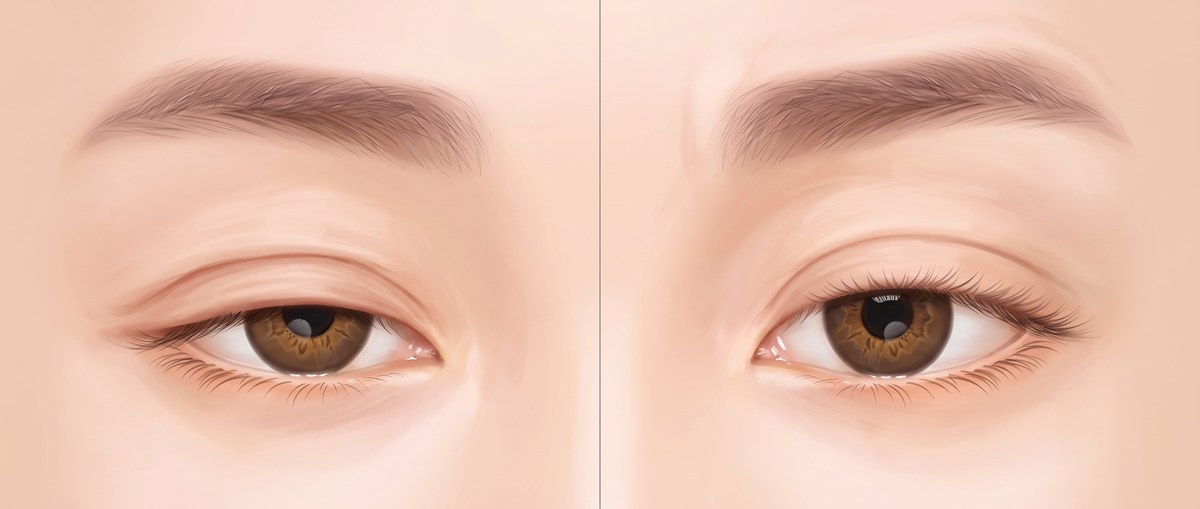
On the left, stretched eyelid skin descends over the eyelashes to cover the eye; on the right, weak eye-opening muscles cause the eyelid margin itself to cover the pupil while the eyebrow is elevated. This is an AI-generated illustration for explanatory purposes.
The skin measuring about 2 cm from the eyebrow to the edge of the upper eyelid when closed shortens to about 1 cm when open. When the eyes open, the skin folds somewhere; if that fold is sufficiently high, it forms a double eyelid, and if low, it becomes an inner double eyelid, appearing as if there is no crease.
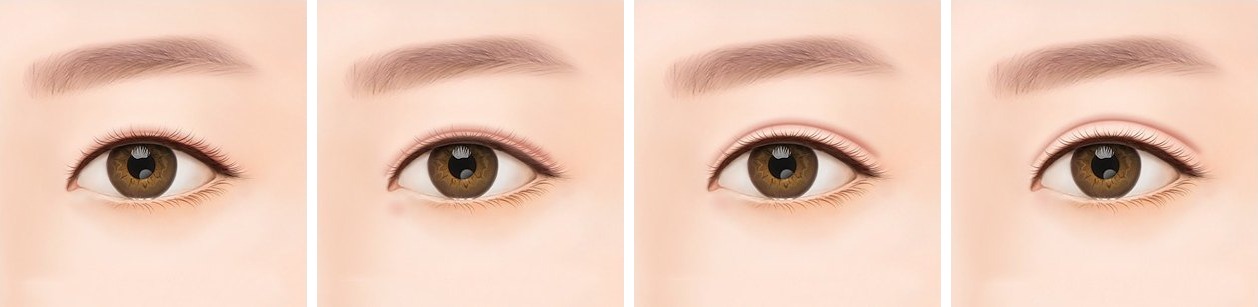
Eye shapes according to crease height. From left: monolids, inner double eyelids, medium double eyelids, and high double eyelids.
Among inner double eyelids, if the crease is positioned very low, the outer skin droops down and covers the eye, which can make it appear as though ptosis is present. In such cases, the eyes can become clear and well-defined with double eyelid surgery alone, without ptosis correction.
Here is the key point — Even if eyes look similarly sleepy on the surface, the appropriate surgery differs depending on whether the cause is skin or muscle.
Ptosis Correction: How to Choose Between Non-Incisional and Incisional?
If the cause lies in the eye-opening muscles, ptosis correction is considered. Ptosis correction is divided into non-incisional methods that plicate Müller's muscle without skin incisions, and incisional methods that shorten or partially resect the levator aponeurosis and Müller's muscle through an incision. Which method is appropriate is determined by evaluating the degree of eye-opening strength.

On the left is non-incisional ptosis correction, which uses suture knots to pull up the eye-opening muscle; on the right is incisional ptosis correction, which reinforces the eye-opening muscle after making an incision.
Non-Incisional Ptosis Correction
- Method — Creating micro-incisions in the eyelid and tying the eye-opening muscle (Müller's muscle) to the tarsal plate with sutures to shorten muscle length
- Indications — Mild ptosis (less than moderate), thin eyelids, and eyes that do not require fat removal
- Limitations — Difficult to correct with non-incisional methods if severe ptosis is present
Incisional Ptosis Correction
- Method — Incising the eyelid skin to remove sagging skin and excess muscle/fat, then anchoring the eye-opening muscle (levator palpebrae superioris) to the tarsal plate to reinforce strength
- Indications — Moderate to severe ptosis, pronounced eyelid sagging, or thick eyelid skin with excessive fat
- Cons — Swelling may last longer during recovery than with non-incisional methods, and an incision scar remains
APEX Plastic Surgery's Non-Incisional Ptosis Correction·Incisional Ptosis Correction standards. The actual method is determined after an examination.
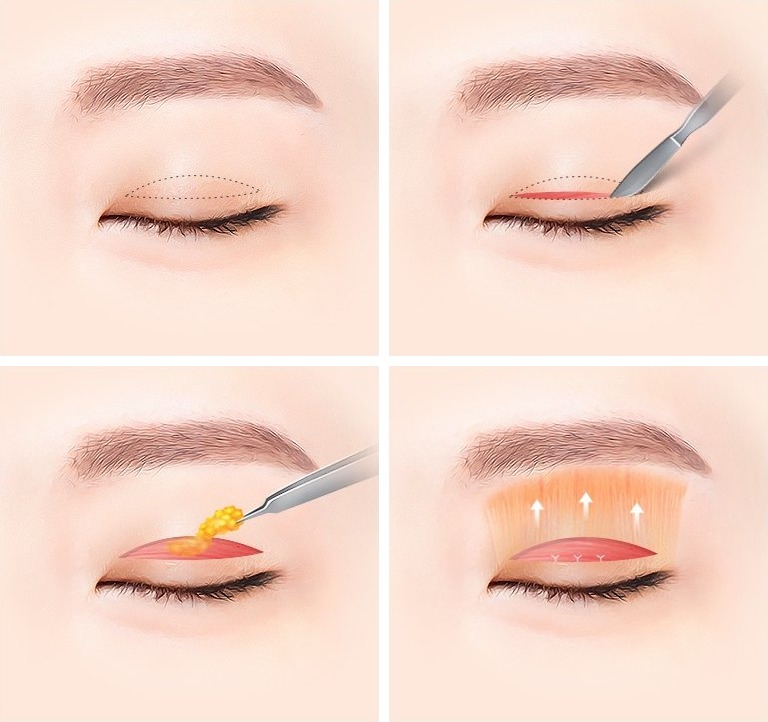
The process of incisional ptosis correction: proceeds in the order of design, incision, fat and muscle trimming, reinforcement of eye-opening muscles, and formation of the double eyelid line; this may vary by individual.
Double Eyelid Surgery Methods Vary Depending on Skin Condition
Double eyelid surgery is divided into the buried suture method (non-incisional), partial incision method, and full incision method according to the incision technique.
- Buried Suture Method (Non-Incisional) — A method that creates a double eyelid line by forming knots through tiny needle punctures without incising the skin. While operative time is relatively short, the crease can easily loosen if the skin is thick, and it is difficult to apply if there is significant sagging skin.
- Partial Incision Method — A method that creates a double eyelid by removing fat through minimal incisions without excising skin. The crease is less likely to loosen than with the buried suture method, and scarring is minimal compared to the full incision method; however, detailed evaluation is required if skin sagging or ptosis is severe.
- Incision Method — A method that creates a crease by incising the skin and removing skin, fat, or muscle as needed. Swelling may persist longer than with the buried suture method, and a scar may remain. When moderate or severe ptosis is present, the incision method is performed.
At APEX Plastic Surgery, procedures are divided into Non-Incisional Double Eyelid, Hybrid Double Eyelid (minimal incision), Incisional Double Eyelid methods. If you have weak eye-opening strength and also desire double eyelids, ptosis correction and double eyelid surgery can be performed together.
Please keep in mind — Postoperative complications may include bleeding, infection, inflammation, scarring, asymmetry, loosening of the double eyelid line, overcorrection or undercorrection of ptosis, and dry eye sensations. Swelling, bruising, the recovery process, and progress vary by individual. Specific precautions are explained in detail during your consultation.
The surgical method is chosen based on your eye condition
“Before undergoing eyelid surgery, one must always take into account the extent of skin laxity, the amount of fat, and the strength of the muscles that open the eyes. Rather than choosing a surgical method based merely on acquaintances' experiences or recommendations, finding the appropriate procedure tailored to individual conditions, facial balance, and overall impression is essential to achieving naturally beautiful eyes.” — Song Hyun-seok, Lead Surgeon
Frequently Asked Questions
What is the difference between ptosis correction and double eyelid surgery?
Double eyelid surgery creates a crease where the skin folds when opening the eyes, whereas ptosis correction reinforces the muscles that lift the eyelids so that they can open sufficiently.
If eyelid-lifting strength is weak and a double eyelid crease is also desired, both procedures can be performed together.
If I strain my forehead when opening my eyes, does that mean I have ptosis?
When ptosis is present, forehead muscles are often overused to open the eyes. However, straining the forehead does not always mean you have ptosis; drooping eyelid skin covering the eyes can also cause this.
Therefore, both eyelid-lifting strength and skin condition are assessed together during the consultation.
I have hidden double eyelids and look sleepy. Do I need ptosis correction?
If the hidden crease sits low and outer skin droops down to cover the eye, there may be no issue with the lifting muscles, meaning double eyelid surgery alone can make the eyes look clear and defined.
If the eyelid-lifting muscles are weak, ptosis correction is considered together.
What should I do if a double eyelid crease made with the non-incisional method comes undone?
If a crease created with the non-incisional (suture) method has come undone two or three times, or is expected to unravel if done with the suture method again, partial incision or incisional methods are considered.
The approach is determined based on skin condition, amount of fat, and eyelid-lifting strength.
What are the surgery duration and recovery period?
At APEX Plastic Surgery, non-incisional ptosis correction takes 30–50 minutes under local or twilight anesthesia, requires no hospitalization, and has a recovery period of about 1–2 weeks. Incisional ptosis correction takes 1 hour to 1 hour 30 minutes under local or twilight anesthesia, requires no hospitalization, involves suture removal after 5 days, and has a recovery period of about 5–7 days.
Double eyelid surgery takes about 30 minutes for non-incisional (recovery 3–5 days), about 30 minutes for hybrid (recovery 5–7 days), and within 1 hour for incisional (recovery 5–7 days); all are performed under local or twilight anesthesia with no hospitalization required.
This may vary depending on the patient's condition and surgical technique.
Before choosing between double eyelids or ptosis correction, we assess eyelid-lifting strength first
What we examine first during consultation
- Eyelid-lifting strength — Degree of pupil exposure when opening the eyes, and whether forehead muscles are engaged
- Eyelid skin — Degree of skin laxity and thickness
- Eyelid fat — Amount of upper eyelid fat
- Current double eyelids — Presence of a crease, fold height, and previous surgical history
- Eye shape and spacing — Epicanthal fold, outer eye corners, and asymmetry
- Facial harmony — Whether the eye shape complements facial balance and overall impression
At APEX Plastic Surgery, board-certified plastic surgeon Dr. Song Hyun-seok provides all consultations and treatments.
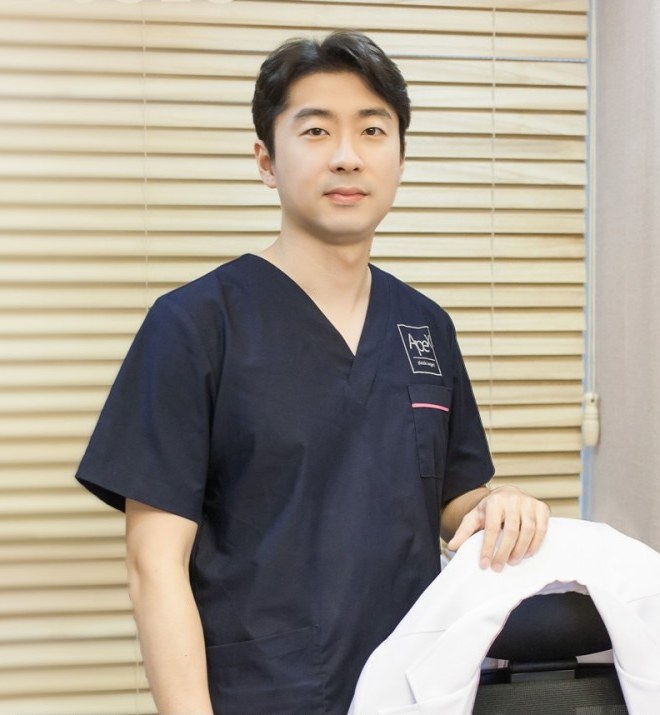
Song Hyun-seok, Head Director · Board-Certified Plastic Surgeon, Ph.D.
This article is intended for medical informational purposes, does not guarantee specific treatment results, and should not replace an in-person medical consultation. The representative image and certain eye illustrations are AI-generated images to assist understanding and do not depict real individuals; all other eye graphics are illustrative diagrams. None of the images in this article are before-and-after surgical comparison photos. Surgery duration, anesthesia, and recovery time are based on standard procedure guidelines on the APEX Plastic Surgery website and may vary by individual. As general surgical complications such as post-operative bleeding, infection, and inflammation can vary in severity from person to person, caution is required. Please ensure you receive a thorough consultation, detailed explanation, and provide informed consent prior to surgery.
APEX CUSTOMER CENTER
Phone number :
02-3453-7907
Clinic Hours
Weekdays
AM 10 : 00 ~ PM 7 : 00
Saturday
AM 10 : 00 ~ PM 4 : 00
(Closed Sundays and holidays)
Subway Line 2, Yeoksam Station Exit 4, Hanjungang Building 3F
The two buildings are adjoined; please enter through the right-hand door.
(The right-hand building with KT on the 1st floor)
How do I make a reservation?
You can book by phone at our main number, 02-3453-7907.
Can I get a consultation in Japanese?
You can reach us via our official Instagram (@apexjapan_official) or X (@apex_surgery).
日本 SNS

Clinic Name : APEX Plastic Surgery
Address : 3F Hanjungang Bldg., 139-1 Teheran-ro, Gangnam-gu, Seoul (646-7 Yeoksam-dong)
CEO : Song Hyun-seok Business Registration No. : 220-10-15955 TEL : 02-3453-7907 FAX : 02-3453-7908
Copyright ⓒ 2026 APEX Plastic Surgery. ALL Rights Reserved.
Apex
[Summit, top]
APEX means ‘the summit,’ ‘the very top.’
with the finest medical technology and a systematized surgical process
our commitment to uncovering the hidden beauty unique to each patient
It embodies the spirit of APEX Plastic Surgery.


