APEX Column
APEX Column
Brought to you by APEX Plastic Surgery
Explore plastic surgery insights and stories.
Anti-Aging Procedures: Deciding Between Lifting and Filler by Looking at Sagging and Hollowness First
Date : 2026-11-12
Views : 58
Sagging, volume loss that causes hollowness, and surface fine lines and elasticity changes all contribute to an aging appearance. When the cause is different, the appropriate method also varies. For anti-aging procedures, it is important to first identify what has changed in your face rather than focusing on procedure names.
The desire to look younger transcends age and gender. However, with so many options like lifting, fillers, fat grafting, and skin procedures, it is easy to feel overwhelmed about where to start. We have summarized how to categorize an aging face into three aspects, what options to consider according to the cause, and what to check before choosing.

AI-generated image for illustrative purposes.
Looking at an Aging Face in Three Categories
The changes that occur in the face with age can be broadly divided into sagging, hollowness, and changes on the skin surface. In some cases, one factor is prominent, while in others, two or three factors are present together.
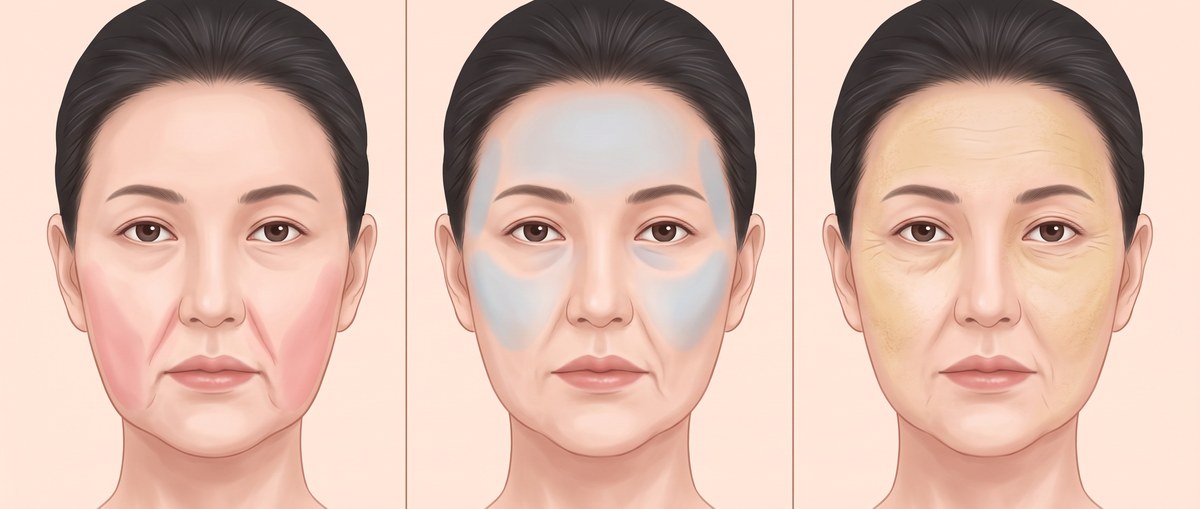
An illustration marking the three aging changes on the same face. From left: sagging cheeks and jawline, volume loss in the forehead, temples, and anterior cheeks, and fine wrinkles and skin texture. This is an AI-generated image to aid understanding.
- Sagging — When the skin and the underlying fat and fascia sag downward together, causing the cheeks to droop and the nasolabial folds and jawline to lose definition
- Hollowness — When fat decreases in previously plump areas such as the forehead, temples, and anterior cheeks, causing the face to appear hollow
- Skin Surface — When fine wrinkles increase and skin elasticity and texture change
The approach to consider varies depending on which change is primarily noticeable. For a sagging face, tightening methods are prioritized; for a hollow face, filling methods; and for skin surface changes, methods that treat the skin layers.
Here is the key point — For anti-aging procedures, the method should be chosen after distinguishing whether the cause is sagging, hollowness, or skin surface changes.
If Sagging Is the Cause, Consider Lifting
For a sagging face, lifting—pulling downward-drooping tissues upward—is considered. Depending on the degree and extent of sagging, it is divided into non-incisional procedures and surgical procedures involving incisions.
- Laser Lifting — A procedure that delivers focused high-intensity focused ultrasound (HIFU) energy into the deep skin layers to stimulate collagen production. It does not require incisions.
- Thread Lift — A procedure that inserts dissolvable threads under the skin using a cannula to lift sagging skin. It does not require incisions.
- Mini Lift — A surgical procedure that makes small incisions in front of the ears or in the temporal area to tighten down to the superficial muscular aponeurotic system (SMAS) layer. It is considered based on the sagging areas, such as nasolabial folds, cheek sagging, and marionette lines.
- SMAS Facelift — A surgical procedure that makes an incision from the front to the back of the ear to tighten both the skin and the superficial muscular aponeurotic system (SMAS) layer together. It addresses overall facial sagging spanning the midface, lower face, and neck.
The SMAS layer is a thin fibrous fascial layer located between the subcutaneous fat layer and the muscle layer. As we age, not only the skin but also the underlying fat, muscle, and fascial layer sag together. Therefore, if the extent of sagging is broad, a facelift surgery that tightens down to the fascial layer is considered. Because facial nerves run beneath the fascial layer, the anatomical structure of the face and the extent of sagging must be thoroughly examined before surgery.
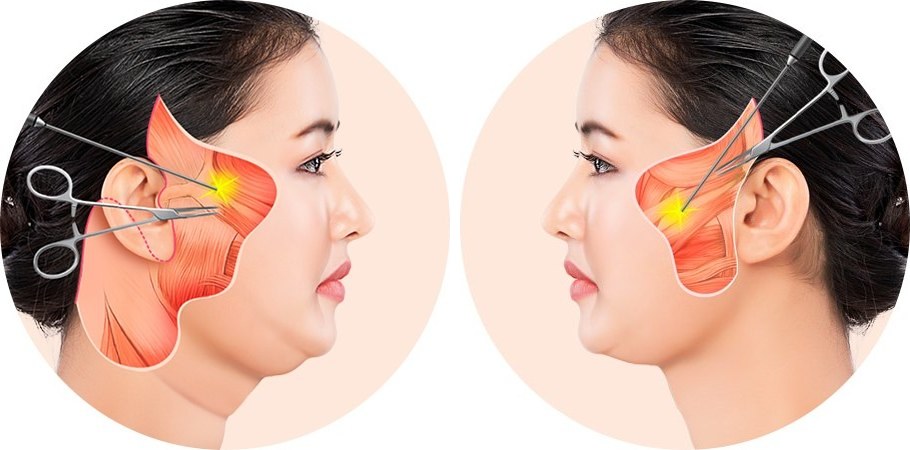
An illustration showing the incision locations and tightening areas (orange) for a SMAS facelift on the left and a mini facelift on the right. The surgical scope is determined after an examination assessing the degree of sagging.
If Hollowness Is the Cause, Look at Methods to Restore Volume
For areas with diminished volume such as the forehead, temples, and anterior cheeks, filling methods are considered. Depending on what is used to fill them, options are divided into fillers and facial fat grafting.
- Filler — A procedure that injects filler to restore volume to areas that need it. It is injected after topical numbing cream is applied.
- Facial Fat Grafting — A surgical procedure where one's own fat is harvested from areas such as the thighs, buttocks, or abdomen, purified via centrifugation, and grafted into hollow areas.
Not all grafted fat survives; a portion is absorbed. Therefore, the grafting volume is determined by taking the expected absorption into account. If autologous fat is difficult to obtain, fillers may be considered instead.

A design showing the target grafting areas marked with dotted lines before facial fat grafting. The actual grafting sites and amounts are determined after consultation.
For Fine Wrinkles and Skin Texture, Look at Procedures That Treat the Skin Layer
For changes in fine wrinkles, elasticity, and skin texture on the skin surface, procedures acting on the skin layer are considered.
- Skin Botox — A procedure in which diluted botulinum toxin is injected evenly in small amounts into the dermal layer of the skin. It is considered for improving fine wrinkles and skin texture.
- Skin Laser — Options include lifting lasers for skin elasticity and fine wrinkles, and CO2 lasers for mole removal. They are chosen according to skin condition and treatment area.

Skin Botox procedure in progress. Small amounts are injected into the superficial layer of the skin using a fine needle.
Even with the same procedure name, laser treatments may utilize different devices. Check during your consultation which device will be used and on which areas it will be performed. After the procedure, moisturizers and sunscreen are recommended for skin recovery. Consistently applying moisturizer is also the fundamental basis of home skin care.
How Anti-Aging Procedures Are Determined
- Consultation and Examination — Sagging, hollowness, and skin elasticity are evaluated alongside facial contours, proportions, and muscle and fat distribution.
- Choosing the Method — The appropriate method for the underlying cause is selected. If two or more are required, whether to perform them sequentially or simultaneously is decided.
- Design — The areas to be lifted or filled are marked on the face.
- Procedure or Surgery — Performed using the chosen method.
- Follow-up Evaluation — For incisional surgeries, patients visit the clinic for suture removal and progress checks.
Please keep in mind — Side effects such as bruising, swelling, pain, infection, asymmetry, scarring, temporary sensory reduction, and surface irregularities may occur after a procedure or surgery. Fillers can rarely cause vascular complications, thread lifts may leave threads palpable or visible, and grafted fat is partially reabsorbed. Recovery times and outcomes vary by individual. Detailed precautions will be explained during your consultation.
Choosing Only the Necessary Procedures Is Crucial
There are numerous anti-aging procedures, and recommendations may vary across clinics. It is best to check the board specialty of your treating physician, understand what your face currently requires, and decide accordingly. Specialist credentials can be verified through the respective medical specialty societies.
“Some clinics may excessively push unnecessary procedures. To choose the right clinic, consulting a board-certified plastic surgeon yields the most accurate advice.” — Dr. Song Hyun-seok, Lead Surgeon
Frequently Asked Questions
Where should I begin with anti-aging procedures?
First, identify which change is most prominent among sagging, hollowness, and skin-surface changes. Consider methods addressing the root cause, and if multiple issues coexist, the sequence is determined after clinical examination.
How do thread lifts and facelift surgery differ?
A thread lift is a non-incisional procedure that inserts dissolvable threads under the skin to elevate tissue. Mini facelifts and SMAS facelifts are surgical procedures involving incisions to tighten down to the SMAS layer. The choice depends on the degree and extent of sagging, as well as your available recovery downtime.
How do fillers and facial fat grafting differ?
Fillers are an injectable procedure that restores volume with dermal filler, whereas facial fat grafting is a surgery where your own fat is harvested, purified, and transplanted. A portion of the grafted fat is naturally absorbed. The choice is determined by the areas and volume to fill, as well as donor fat availability.
What are the procedure times and anesthesia types for each method?
The reference guidelines at APEX Plastic Surgery are as follows:
- Laser Lifting — Procedure time: within 10 minutes, topical anesthetic cream
- Thread Lift — Procedure time: approximately 10 minutes, local anesthesia or IV sedation
- Mini Lift — Surgery time: within 1 hour, IV sedation, suture removal after 7–10 days, recovery approximately 1 week
- SMAS Facelift — Surgery time: approximately 4 hours, IV sedation, suture removal after 7–10 days, recovery approximately 2 weeks
- Filler — Procedure time: within 10 minutes, topical anesthetic ointment
- Facial Fat Grafting — Surgery time: approximately 1 hour, IV sedation, suture removal after 7 days
- Skin Botox — Procedure time: within 5 minutes, topical anesthetic ointment
None require hospitalization. Details may vary depending on patient condition and treatment scope.
APEX Plastic Surgery's Laser Lifting·Thread Lift·Mini Lift·SMAS Face Lift·Filler·Facial Fat Grafting·Skin Botox·Skin Laser guidelines. The actual method is determined after examination.
What should I check when receiving laser treatments?
During your consultation, check which equipment is used and to what depth and area of the skin it will be delivered. After treatment, moisturizers and sunscreens are recommended to support skin regeneration.
Anti-Aging Solutions Are Decided by Evaluating Sagging, Hollowness, and Skin Quality
What we examine first during consultation
- Sagging — How far and to what extent the cheeks, nasolabial folds, jawline, and neck have sagged
- Hollowness — Whether there are areas with volume loss, such as the forehead, temples, or anterior cheeks
- Skin — Fine lines, skin elasticity, and skin texture
- Facial Contours and Proportions — How facial contours have shifted due to sagging and wrinkles
- Previous procedures — Whether you have had prior treatments like fillers, thread lifts, or botulinum toxin, and when
- Recovery timeline — The recovery downtime you can allocate if opting for incisional surgery
- Facial harmony — Whether the anticipated changes harmonize with your current facial impression
At APEX Plastic Surgery, board-certified plastic surgeon Dr. Song Hyun-seok provides all consultations and treatments.
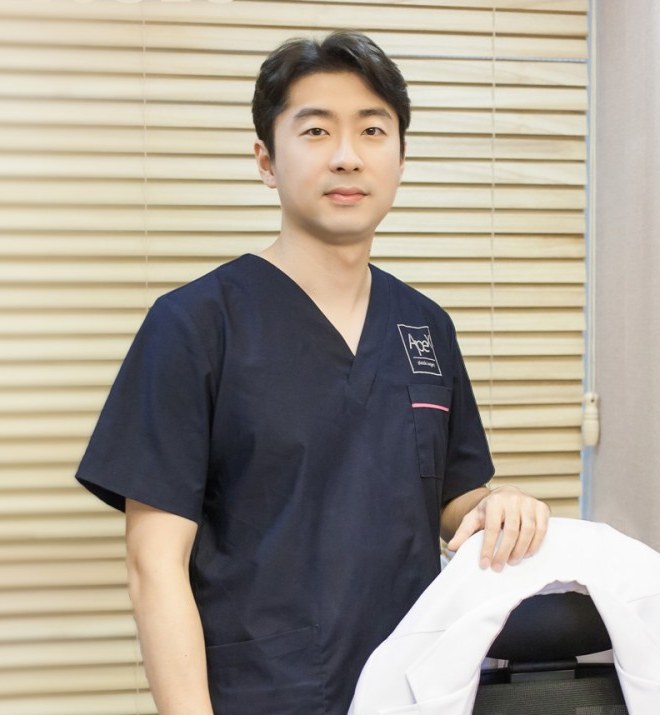
Song Hyun-seok, Head Director · Board-Certified Plastic Surgeon, Ph.D.
This article is provided for medical informational purposes, does not guarantee specific clinical results, and does not replace medical evaluation by a physician. The featured image and aging-change diagrams are AI-generated illustrations for conceptual understanding and do not depict real individuals; the facelift diagrams, fat grafting design photo, and Skin Botox treatment photo are informational images from the APEX Plastic Surgery website. None of the images in this article are before-and-after comparisons. Times, anesthesia, suture removal, and recovery periods are reference standards from the APEX Plastic Surgery website and may vary individually. Common post-procedure side effects such as bruising, swelling, and infection can differ in severity by person, so careful consideration is advised. Please undergo thorough consultation, explanation, and consent prior to any procedure or surgery.
APEX CUSTOMER CENTER
Phone number :
02-3453-7907
Clinic Hours
Weekdays
AM 10 : 00 ~ PM 7 : 00
Saturday
AM 10 : 00 ~ PM 4 : 00
(Closed Sundays and holidays)
Subway Line 2, Yeoksam Station Exit 4, Hanjungang Building 3F
The two buildings are adjoined; please enter through the right-hand door.
(The right-hand building with KT on the 1st floor)
How do I make a reservation?
You can book by phone at our main number, 02-3453-7907.
Can I get a consultation in Japanese?
You can reach us via our official Instagram (@apexjapan_official) or X (@apex_surgery).
日本 SNS

Clinic Name : APEX Plastic Surgery
Address : 3F Hanjungang Bldg., 139-1 Teheran-ro, Gangnam-gu, Seoul (646-7 Yeoksam-dong)
CEO : Song Hyun-seok Business Registration No. : 220-10-15955 TEL : 02-3453-7907 FAX : 02-3453-7908
Copyright ⓒ 2026 APEX Plastic Surgery. ALL Rights Reserved.
Apex
[Summit, top]
APEX means ‘the summit,’ ‘the very top.’
with the finest medical technology and a systematized surgical process
our commitment to uncovering the hidden beauty unique to each patient
It embodies the spirit of APEX Plastic Surgery.


