APEX Column
APEX Column
Brought to you by APEX Plastic Surgery
Explore plastic surgery insights and stories.
Double Eyelid & Rhinoplasty Scars: Where Do Incision Lines Remain and When Do They Mature?
Date : 2026-11-10
Views : 29
Any incision that reaches into the deeper layer of the skin, the dermis, leaves a scar, and once formed, a scar can be reduced or made less visible, but it can never be completely eliminated. Therefore, regarding surgical scars, the first things to check are where the incision is placed, how it is sutured, and how it is monitored while it settles.
“Will it leave a scar?” is one of the questions patients preparing for surgery are most curious about. Because the eyes and nose are at the center of the face, even a small incision line can be a concern, and scars remain long after surgery. Here, we outline why scars form, where incisions are placed in eye and nose surgery, how long scars take to settle, how existing scars are treated, and what to check during a consultation.
AI-generated image for illustrative purposes.
Surgical scars remain wherever an incision reaches the dermis
The skin consists of the outer epidermis, the dermis beneath it, and the deeper subcutaneous fat layer. When a wound reaches the dermal layer or deeper, that space is filled with scar tissue, leaving a scar in some form. Surgical incisions are no exception. Once a scar has formed, it can be minimized or made less noticeable, but it cannot be fundamentally eliminated.
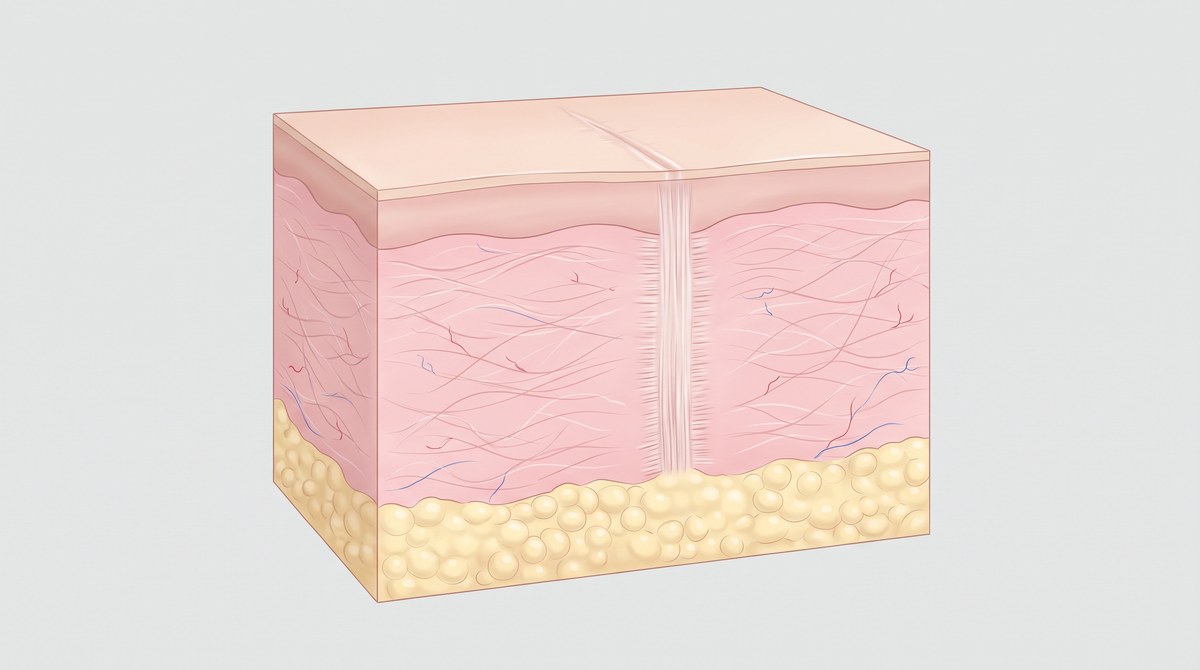
A cross-sectional diagram of the skin. From the top: epidermis, dermis, and fat layer; the light vertical band running through the center is scar tissue filling an incision that reached the dermis. This is an AI-generated diagram for illustrative purposes.
The way a scar forms depends on skin characteristics, as well as the size and location of the incision. In areas where tension from surrounding skin is strong, such as the shoulders or legs, scars tend to widen, or hypertrophic scars—where the scar becomes red and raised—easily develop. Scars running parallel to the direction of skin creases are less noticeable than those that do not. This is why surgery begins by determining where and in what direction to place the incision line.
Where are incision lines left in double eyelid and eye surgery?
In eye surgery, the incision site varies depending on the procedure. Based on the surgical guides on the APEX Plastic Surgery website, they are summarized as follows:
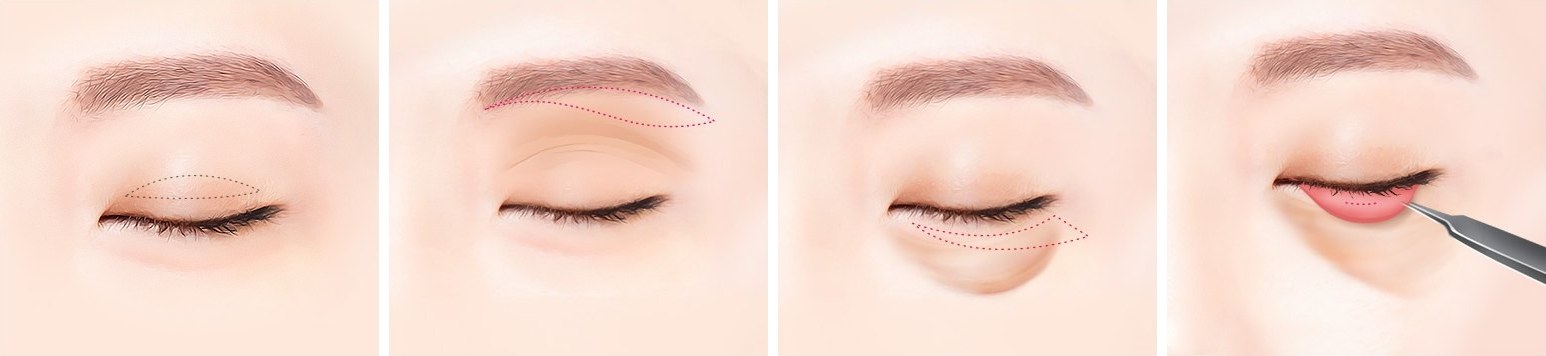
Incision sites for eye surgery. From left to right: incisional double eyelid surgery designed along the double eyelid line; sub-brow lift designed directly beneath the eyebrow; lower blepharoplasty designed directly beneath the lower eyelashes; and transconjunctival lower eyelid fat repositioning incising the conjunctiva inside the lower eyelid.
- Buried suture method (non-incisional double eyelid) — Sutures are placed through tiny needle punctures without incising the skin to fix the double eyelid line (Non-Incisional Double Eyelid)
- Partial incision method (hybrid double eyelid) — Small incisions are made along the double eyelid line to adjust fat and muscle, and the line is fixed with sutures and closed (Hybrid Double Eyelid)
- Incisional Double Eyelid — An incision is made along the eyelid at the designed double eyelid height. The incision line remains along the crease (Incisional Double Eyelid)
- Sub-Brow Lift — An incision is made close beneath the eyebrow. The incision line remains along the lower border of the eyebrow (Sub-Brow Lift)
- Lower Blepharoplasty — An incision is made along the lower lash line, and the skin is repositioned and closed with fine sutures (Lower Blepharoplasty)
- Transconjunctival Fat Repositioning — An incision is made on the conjunctiva inside the lower eyelid. The outer skin is not incised, and no stitches are removed (Transconjunctival Fat Repositioning)
When incision lines are placed along natural boundaries such as the double eyelid crease, eyebrow, or lash line, they can be less noticeable even at the same length. However, the visibility of scars varies depending on skin conditions and other factors. The criteria for choosing a double eyelid surgery method are Double Eyelid Surgery Methods Column.
Incision lines for rhinoplasty are placed inside the nostrils and on the columella
Rhinoplasty is divided into open and closed approaches depending on the incision method. Alar reduction, which narrows wide nostrils, involves incising the skin around the alar base.
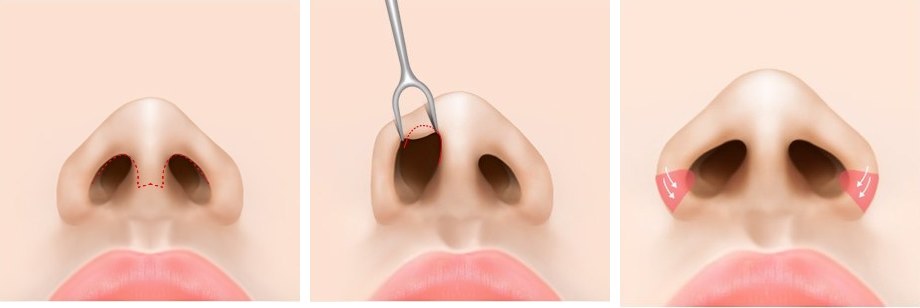
Incision sites for nose surgery. From left to right: open rhinoplasty incising both inside the nostrils and on the columella; closed rhinoplasty incising only inside the nostrils; and alar reduction removing a wedge-shaped portion of skin at the base of the nostril; red areas indicate incision sites.
- Open — Incisions are made both inside the nostrils and across the columella. Because the internal structures of the nose can be directly visualized and corrected, this approach is applied to most primary and revision rhinoplasties. Depending on skin conditions, a scar may remain on the columella, and recovery takes longer than with a closed approach
- Closed — Incisions are made only inside the nostrils. There are no externally visible incision lines, but because the surgical view is narrow, it is considered when the area to be corrected is limited
- Alar Reduction — A wedge-shaped segment of skin from the lower alar is excised and sutured. The incision line remains along the crease between the alar and cheek. There is also a method of gathering and tying the nostrils with sutures (Alar Reduction)
The choice between open and closed rhinoplasty is not made based on scars alone. The method is determined by how much the nasal structure needs to be corrected, which also determines where the incision line is placed (Low Nose Rhinoplasty).
Here is the key point — The first step in reducing surgical scars is knowing before surgery where the incision line will be placed and how long it will be. Even for surgery in the same area, the incision site and length vary depending on the technique.
Incisions are closed with fine sutures and stitches are removed
At the end of surgery, the incision site is meticulously closed with fine sutures. The timing of suture removal and the number of follow-up clinic visits vary by procedure.
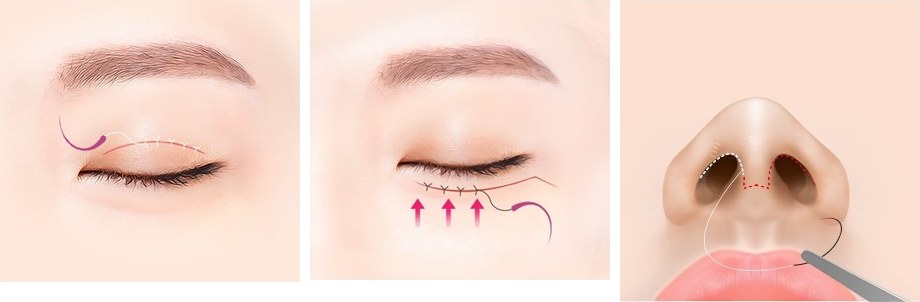
Diagram of the suturing stages. From left to right: suturing for hybrid double eyelid surgery, lower blepharoplasty, and open rhinoplasty; details may vary by individual.
- Eye surgery — Partial incision/incisional double eyelid, sub-brow lift, and lower blepharoplasty: suture removal after 5 days, 1–2 clinic visits
- Buried suture method (non-incisional double eyelid) — Suture removal not required, or between 1–5 days if needed
- Transconjunctival Fat Repositioning — No suture removal
- Rhinoplasty and alar reduction — Suture removal after 7 days, 2–3 clinic visits
Even after stitches are removed and the initial recovery period has passed, the scar has not fully settled. Suture removal and the recovery period are only the first stages of wound healing; scars continue to settle over several months thereafter.
It takes 6 to 18 months for a scar to mature
It is generally estimated that it takes 6 to 18 months for a scar to fully settle (mature). The time required varies depending on skin characteristics, as well as the size and location of the scar.
Before a scar matures, it has many fragile capillaries, the surrounding tissue is swollen, and elasticity is reduced. Performing revision surgery at this stage is difficult and may yield poor results. Therefore, the established principle is to perform scar revision only after the scar has fully settled.
APEX Plastic Surgery Eye Revision Surgery guidelines also follow this standard. It generally takes about 6 months to a year for eye tissue to stabilize, and revision surgery after an incisional procedure is performed after 6 months or more, once the surgical scar has sufficiently stabilized.
For existing scars, the method is determined by evaluating location, direction, and shape
Methods for revising scars are determined by evaluating the scar's location, direction, size, and shape, as well as the condition of the surrounding skin. Techniques used in scar revision include the following:
- Linear scars parallel to wrinkle lines — The scar is excised, and the skin is sutured in multiple layers (simple scar revision)
- Scars misaligned with wrinkle lines — The scar is incised in a Z-shape (Z-plasty) or a zigzag pattern (W-plasty) to make the resulting scar finer and less noticeable
- Wide scars that are difficult to remove all at once — Removed in multiple stages (serial excision), or operated on after inserting a tissue expander beneath the skin to stretch adjacent tissue
- Depressed scars lower than the surrounding area — The height difference with the surrounding skin is minimized using fillers or autologous fat grafting (Filler)
If severe scarring remains after double eyelid surgery, APEX Plastic Surgery's revision eyelid surgery excises the scarred portion to reduce it while redefining the double eyelid crease, provided sufficient eyelid tissue and skin remain. If eyelid tissue is insufficient, fat grafting may also be performed.
Scar revision is not necessary for every scar. For small scars in areas with high skin tension, such as the shoulders or legs, surgery typically yields minimal improvement and is rarely performed.
Please keep in mind — Postoperative complications such as bleeding, infection, inflammation, scarring, hypertrophic scars, and asymmetry may occur. Depending on the surgical technique, incision lines remain along the double eyelid crease, under the eyebrow, beneath the lower eyelashes, on the columella, or along the border between the alar base and cheek. The visibility of scars and the maturation period vary depending on skin characteristics and the treated area, and even scar revision cannot completely eliminate a scar. Important precautions will be explained in detail during your consultation.
Preoperative consultation comes first
“Patients often decide on plastic surgery to overcome insecurities and regain lost confidence; however, unexpected surgical scars can create an emotional burden and significantly reduce postoperative satisfaction. Even though eye and nose surgeries have become widespread, thorough preparations for safety must be made. For satisfying surgical outcomes, it is best to consult with a specialist possessing extensive clinical experience and know-how before making a prudent decision.” — Song Hyun-seok, Head Director
During your consultation, receive guidance on where incision lines will remain, how sutures are placed, when stitches are removed, and what to monitor while the scar settles.
Frequently Asked Questions
Does the non-incisional method (buried suture) leave no scars?
The non-incisional method secures the double eyelid line through tiny needle punctures without skin incisions, so no incision lines are created. However, the extent of small marks or swelling at the needle insertion points varies from person to person.
If the eyelids are thick or have significant sagging skin, the non-incisional method may not be suitable, so the surgical approach is determined based on the condition of the eyelids.
Is the scar completely healed once the stitches are removed?
Stitch removal is only the initial stage of wound closure. It generally takes about 6 to 18 months for a scar to fully mature. During this period, follow the advised clinic visit schedule and precautions, and consult your doctor if you have concerns about the scar.
Is rhinoplasty scarring visible externally?
Closed rhinoplasty involves incisions made only inside the nostrils, leaving no externally visible incision line. Open rhinoplasty also incises the columella, so a scar may remain on the columella depending on skin conditions.
The choice of method is determined by how much the nasal structure needs to be corrected.
If I am unhappy with the scar, when can it be revised?
As a rule, scar revision surgery is performed after the scar has fully matured. Based on APEX Plastic Surgery's revision eye surgery guidelines, revision after an incisional procedure is conducted after at least 6 months, once the scar has sufficiently stabilized.
If any abnormality is suspected immediately after surgery, do not wait; have it evaluated at the clinic first.
What if I am prone to scarring?
If you have a history of scars from previous surgeries or wounds spreading wide or becoming red and raised, please inform us in advance during your consultation. Because scar formation varies according to skin characteristics, past healing experiences are taken into account when determining the surgical approach and incision placement.
Evaluating surgical scars begins with incision placement and the maturation period
What we examine first during consultation
- Incision location — Where and how long the incision line remains depending on the surgical method
- Surgical method — Methods tailored to the extent of correction, such as incisional vs. non-incisional, or open vs. closed
- Skin characteristics — Skin thickness and condition, and whether previous scars widened or became raised
- Prior surgeries — Previous surgeries in the same area and remaining scars
- Recovery timeline — Schedule for stitch removal and follow-up clinic visits
- Maturation period — What to monitor while the scar settles and when to schedule follow-up consultations
At APEX Plastic Surgery, board-certified plastic surgeon Dr. Song Hyun-seok provides all consultations and treatments.
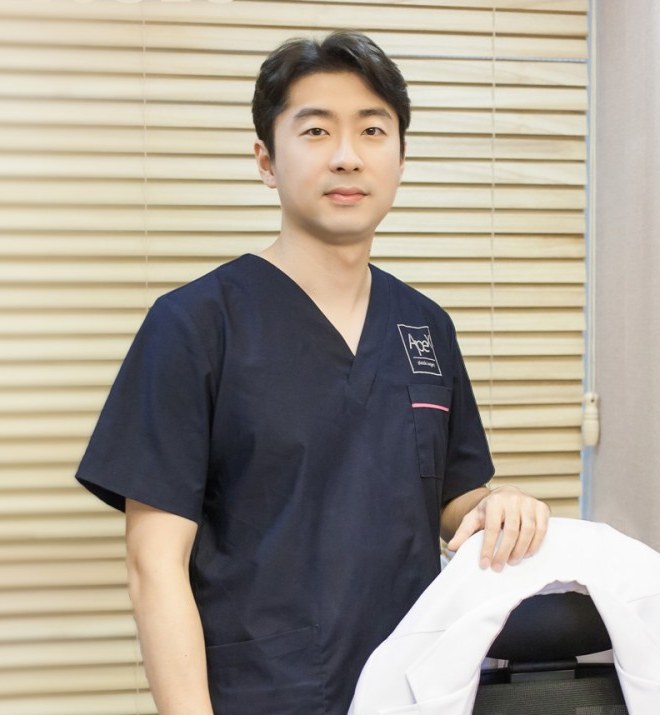
Song Hyun-seok, Head Director · Board-Certified Plastic Surgeon, Ph.D.
This article is provided for informational purposes only, does not guarantee specific treatment results, and cannot replace a clinical examination by medical professionals. The featured image and skin cross-section illustration are AI-generated images to aid understanding, and the remaining eye and nose diagrams are explanatory illustrations. None of the images in this article are before-and-after comparison photos. Information regarding stitch removal, follow-up visits, and recovery periods is based on procedure guides from the APEX Plastic Surgery website, and scar maturation periods are general clinical benchmarks; all may vary individually. Complications that can generally occur after surgery, such as bleeding, infection, and inflammation, may differ in severity among individuals, so caution is required. Please receive thorough consultation, explanation, and consent prior to surgery.
APEX CUSTOMER CENTER
Phone number :
02-3453-7907
Clinic Hours
Weekdays
AM 10 : 00 ~ PM 7 : 00
Saturday
AM 10 : 00 ~ PM 4 : 00
(Closed Sundays and holidays)
Subway Line 2, Yeoksam Station Exit 4, Hanjungang Building 3F
The two buildings are adjoined; please enter through the right-hand door.
(The right-hand building with KT on the 1st floor)
How do I make a reservation?
You can book by phone at our main number, 02-3453-7907.
Can I get a consultation in Japanese?
You can reach us via our official Instagram (@apexjapan_official) or X (@apex_surgery).
日本 SNS

Clinic Name : APEX Plastic Surgery
Address : 3F Hanjungang Bldg., 139-1 Teheran-ro, Gangnam-gu, Seoul (646-7 Yeoksam-dong)
CEO : Song Hyun-seok Business Registration No. : 220-10-15955 TEL : 02-3453-7907 FAX : 02-3453-7908
Copyright ⓒ 2026 APEX Plastic Surgery. ALL Rights Reserved.
Apex
[Summit, top]
APEX means ‘the summit,’ ‘the very top.’
with the finest medical technology and a systematized surgical process
our commitment to uncovering the hidden beauty unique to each patient
It embodies the spirit of APEX Plastic Surgery.


